
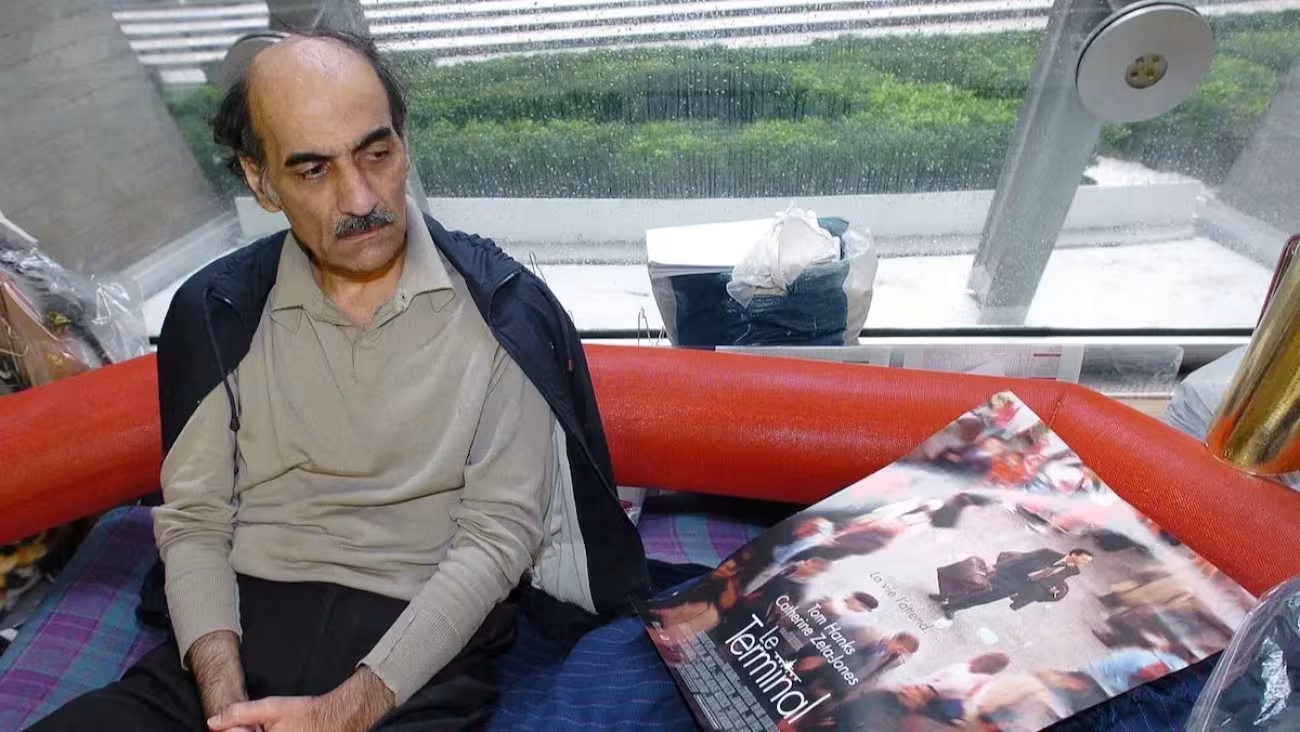
Mehran Karimi Nasseri, the Iranian man whose extraordinary life inspired Steven Spielberg's 2004 film The Terminal, died at Paris Charles de Gaulle Airport on November 12, 2022, after suffering a heart attack. He was found in Terminal 2F, where airport police and medical personnel attempted to save him but were unsuccessful.
Nasseri became internationally known after spending approximately 18 years living inside Charles de Gaulle Airport in France. From 1988 until 2006, he made Terminal 1 his home, sleeping on a red plastic bench, keeping his belongings in luggage carts and relying partly on assistance from airport employees.
His unusual circumstances originated from a complicated immigration and documentation dispute that left him unable to travel normally or establish a stable legal residence. Although he eventually received opportunities to resolve his immigration status, he continued living at the airport for several years.
His story attracted international attention and inspired The Terminal, starring Tom Hanks as Viktor Navorski, a fictional traveler trapped inside New York's John F. Kennedy International Airport.
However, Nasseri's real experiences were considerably more complicated than the Hollywood version. His death also brought renewed attention to the extraordinary circumstances that kept him in an airport for nearly two decades.
Who Was Mehran Karimi Nasseri?
Mehran Karimi Nasseri was an Iranian refugee and long-term resident of Paris Charles de Gaulle Airport. He became known internationally through his unusual living arrangement, which attracted journalists, filmmakers, travelers and airport employees.
Born in approximately 1945 in Masjed Soleiman, in Iran's Khuzestan province, Nasseri reportedly left Iran in 1974 to study in Britain.
He later described being imprisoned and expelled from Iran following political protests against the Shah. However, important parts of his personal history were disputed, and different accounts of his early life appeared in international reporting.
After experiencing difficulties with his identity and refugee documents in Europe, he eventually arrived at Charles de Gaulle Airport in August 1988.
He became known among airport employees as Sir Alfred or Lord Alfred. The nickname originated from correspondence with British authorities in which a letter addressed to "Sir Alfred" was interpreted by Nasseri as a formal title.
His daily life gradually became associated with Terminal 1, where he maintained a relatively organized routine despite having no conventional home.
Mehran Karimi Nasseri Quick Facts
| Full name | Mehran Karimi Nasseri |
| Other names | Sir Alfred, Lord Alfred, Alfred Mehran |
| Birth year | Approximately 1945 |
| Birthplace | Masjed Soleiman, Khuzestan, Iran |
| Nationality and background | Iranian |
| Date of death | November 12, 2022 |
| Age at death | Reported as 76 or 77; sources differ |
| Place of death | Charles de Gaulle Airport, Paris, France |
| Reported cause of death | Heart attack |
| Airport residence | Terminal 1, 1988–2006 |
| Total time at airport | Approximately 18 years |
| Occupation | Writer and public figure |
| Autobiography | The Terminal Man (2004) |
| Film inspired by his life | The Terminal (2004) |
| Film director | Steven Spielberg |
| Lead actor | Tom Hanks |
His exact date of birth was not consistently documented in contemporary reports, which explains why publications described him as either 76 or 77 when he died.
How Did Mehran Karimi Nasseri Become Trapped at Charles de Gaulle Airport?
Nasseri's unusual situation began with a complicated journey through Europe and problems involving his identity and refugee documentation.
He reportedly left Iran in 1974 to study in Britain. According to accounts he gave to journalists, he later returned to Iran, where he was arrested and expelled following his involvement in protests against the Shah.
He subsequently sought political asylum in several European countries.
In 1981, he reportedly received refugee status through the United Nations refugee system in Belgium. This recognition provided a basis for his residence and travel documentation in Europe.
However, his subsequent attempts to travel to Britain became complicated by the absence of valid identity documents.
The Disputed Story of His Missing Documents
One of the most frequently repeated explanations is that Nasseri's briefcase containing his refugee documents was stolen at a Paris railway station.
Without the necessary paperwork, he struggled to prove his identity and establish his right to travel between European countries.
He reportedly attempted to travel to Britain to locate his mother, whom he believed lived in Glasgow. However, British immigration authorities refused him entry because he could not provide the required documentation.
He was subsequently returned to France.
His situation became increasingly complicated because he lacked the documents needed to travel elsewhere, while French authorities also faced difficulties determining how to resolve his immigration status.
There is an important historical qualification: the missing-document story is disputed. Some accounts suggest that he lost the papers, while others indicate that he may have discarded or deliberately abandoned them. His personal explanations also changed over time.
Andrew Donkin, the British writer who collaborated with Nasseri on his autobiography, later described the precise details of his background and missing paperwork as difficult to establish.
Why Did Mehran Karimi Nasseri Live at the Airport for 18 Years?
In August 1988, Nasseri began living at Charles de Gaulle Airport after being unable to resolve his immigration and travel-document problems.
His circumstances created an unusual legal situation. He could not easily board an international flight without valid documents, while leaving the airport could expose him to immigration enforcement because he could not establish his identity and legal status.
A French court ruled in 1992 that he could not be expelled from the airport because he had entered the airport legally as a refugee. However, this ruling did not immediately provide him with permission to enter France as an ordinary resident.
Consequently, the airport became his living environment.
For years, he remained in Terminal 1, where airport employees and regular travelers gradually became familiar with his presence.
His Daily Life Inside Terminal 1
Nasseri's living arrangements were unusual but surprisingly organized.
He occupied a section of the terminal near the departure area, where he slept on a red plastic bench and surrounded himself with luggage carts, boxes, newspapers and personal belongings.
He developed a daily routine that included reading, writing, listening to the radio and observing travelers passing through the airport.
His activities included:
- Sleeping: He used a red plastic bench in Terminal 1 as his regular sleeping area.
- Writing: He maintained extensive handwritten diaries documenting his thoughts and experiences.
- Reading: Newspapers, magazines and books became an important part of his daily routine.
- Personal hygiene: He used airport facilities to wash, shave and maintain his appearance.
- Eating: He purchased food from airport restaurants and sometimes received assistance from employees.
- Social interaction: He developed relationships with airport workers, shop employees and travelers.
His belongings gradually accumulated around his bench, creating a small personal area in an otherwise public environment.
Airport employees became familiar with him, and some provided food vouchers and other assistance.
His presence also attracted curious travelers, photographers and journalists, eventually turning him into an internationally recognized figure.
Why Didn't Mehran Karimi Nasseri Leave the Airport After Receiving Refugee Documents?
One of the most surprising aspects of Nasseri's story is that his situation eventually changed, but he still remained at Charles de Gaulle.
In 1999, French authorities reportedly granted him a temporary residence permit and refugee travel documentation, providing a potential way to leave the airport and establish a life outside the terminal.
Belgian authorities had also made arrangements concerning his refugee documentation.
However, Nasseri refused to sign certain documents because he disagreed with how his identity and personal information were recorded.
He had increasingly identified himself as Sir Alfred Mehran rather than accepting correspondence and paperwork using the name Mehran Karimi Nasseri.
His reluctance to accept the documents became a major obstacle to resolving his situation.
There were also reports that years of living at the airport had made him increasingly accustomed to its environment and uncomfortable with the prospect of leaving.
His circumstances therefore evolved from an initial immigration problem into a much more complicated personal situation.
When Did Mehran Karimi Nasseri Finally Leave Charles de Gaulle Airport?
Nasseri's long-term stay in Terminal 1 ended in July 2006, when he was hospitalized because of health problems.
He had lived inside the airport for approximately 18 years, making his case one of the most extraordinary examples of prolonged airport residence in modern history.
After leaving the hospital, he spent subsequent years living in accommodation and shelters in Paris.
Although he was no longer permanently based in Terminal 1, his connection with Charles de Gaulle remained an important part of his identity.
He had become internationally recognized as the man who lived in an airport, and his unusual experience continued attracting media attention.
Why Did Mehran Karimi Nasseri Return to the Airport Before His Death?
In the weeks before his death in November 2022, Nasseri returned to Charles de Gaulle Airport.
According to an airport authority official quoted by international news agencies, he had been living at the airport again shortly before his death.
Reports indicated that he had spent much of the money received from the film-rights agreement connected to his life story.
However, the exact reasons for his return were not fully established in the public reporting.
His return was particularly striking because he had already spent many years living outside the airport after his hospitalization in 2006.
His final stay was in Terminal 2F rather than the Terminal 1 departure area where he had spent most of his famous 18-year period.
Mehran Karimi Nasseri Dies After a Heart Attack at Charles de Gaulle Airport
Mehran Karimi Nasseri died on Saturday, November 12, 2022, at Charles de Gaulle Airport in Paris.
According to an official from the Paris airport authority, he suffered a heart attack in Terminal 2F around midday.
Airport police and medical personnel responded to the emergency and attempted to save him, but their efforts were unsuccessful.
His death was reported by the Associated Press and subsequently covered by major international media organizations, including BBC, The Guardian, CBS News and Al Jazeera.
He was reportedly 76 or 77 years old, depending on the publication's account of his birth year and age.
His death at the airport where he had spent such a significant portion of his life created a particularly poignant conclusion to an extraordinary personal story.
It also renewed interest in the legal and personal circumstances that had kept him in the terminal for nearly two decades.
The Terminal: How Mehran Karimi Nasseri Inspired the Tom Hanks Movie
Nasseri's unusual life attracted the attention of Hollywood and became the inspiration for Steven Spielberg's 2004 film The Terminal.
The movie stars Tom Hanks as Viktor Navorski, a traveler from the fictional Eastern European country of Krakozhia who arrives at John F. Kennedy International Airport in New York.
After a political revolution takes place in his home country, his travel documents become invalid. American immigration authorities consequently refuse him entry, while he is also unable to return home.
He is forced to remain inside the airport's international transit area while waiting for his legal situation to be resolved.
His experiences gradually become a story about survival, friendship, love and human connection.
Did Steven Spielberg Pay for the Rights to Nasseri's Story?
Yes. Steven Spielberg's production company, DreamWorks, reportedly acquired the rights to Nasseri's life story in 2003.
Contemporary reporting in The Guardian and later coverage by the Associated Press and other outlets documented the agreement.
However, reports have cited different figures for the payment. Some publications reported approximately $250,000, while The Guardian reported a payment of around $300,000 in 2004.
Because the publicly reported figures differ, the precise amount should not be treated as conclusively established.
Nasseri reportedly received the money through an account connected to the airport's postal facilities.
The agreement allowed his extraordinary experiences to be adapted into a fictional Hollywood production.
How Is the Real Story Different From The Terminal?
Although The Terminal drew inspiration from Nasseri's experience, it is not a documentary or a direct recreation of his life.
The filmmakers changed several important elements to create a fictional story suitable for a mainstream audience.
| Real-life Mehran Karimi Nasseri | The Terminal movie |
|---|---|
| Iranian man with a complicated refugee and immigration history. | Viktor Navorski, a fictional traveler from Krakozhia. |
| Lived at Charles de Gaulle Airport in Paris, France. | Stranded at John F. Kennedy International Airport in New York. |
| Arrived at the airport in August 1988. | Arrives after a political revolution invalidates his country's travel documents. |
| Faced problems involving identity and refugee documentation. | Cannot enter the United States or return to his fictional homeland because of political circumstances. |
| Spent approximately 18 years living in Terminal 1. | Experiences a fictional series of adventures and relationships inside the airport. |
| Eventually left the airport after hospitalization in 2006. | Receives a narrative resolution that differs from Nasseri's actual experience. |
The film also includes fictional characters such as airport official Frank Dixon, played by Stanley Tucci, and flight attendant Amelia Warren, played by Catherine Zeta-Jones.
These characters and their relationships with Viktor Navorski were created for the movie rather than being direct representations of people in Nasseri's life.
The film therefore uses the central concept of a person becoming trapped in an international airport but substantially changes the circumstances, characters and events.
The Terminal Man: Nasseri's Autobiography
In addition to inspiring a Hollywood film, Nasseri documented his experiences in an autobiography titled The Terminal Man, published in 2004.
The book was written with the assistance of British author Andrew Donkin, who spent approximately three weeks interviewing Nasseri at Charles de Gaulle Airport.
Donkin later explained that reconstructing Nasseri's personal history was challenging because different accounts of his background and the circumstances surrounding his missing documents did not always agree.
The autobiography explored his personal experiences, memories, identity and life inside the airport.
It also provided a more personal perspective on the challenges of living in an environment designed for temporary travelers rather than permanent residents.
Unlike the Hollywood adaptation, the autobiography focused on Nasseri's own account of his life and his understanding of the events that brought him to Paris.
Other Films and Artistic Works Inspired by His Life
Nasseri's experiences attracted attention beyond Spielberg's Hollywood production.
His story influenced several artistic projects that explored themes of displacement, identity, immigration and the unusual experience of being unable to leave an airport.
- Lost in Transit (1993): A French film directed by Philippe Lioret, also known as Tombé du ciel, inspired by Nasseri's circumstances.
- Flight (1998): An opera composed by Jonathan Dove that incorporates themes associated with an individual trapped in an airport.
- Sir Alfred of Charles de Gaulle Airport (2001): A documentary exploring his life and unusual residence at the airport.
- The Terminal Man (2004): His autobiography, co-written with Andrew Donkin.
- The Terminal (2004): Steven Spielberg's Hollywood film starring Tom Hanks.
These projects demonstrate how a complicated immigration situation developed into a broader cultural story about human identity and belonging.
Why Mehran Karimi Nasseri's Story Became an International Phenomenon
Nasseri's story attracted global attention because it combined an unusual personal experience with important questions about immigration, refugee protection and identity.
Airports are generally designed as temporary spaces. Travelers arrive, complete immigration procedures and continue to their destinations.
Nasseri's circumstances turned that temporary environment into his home for approximately 18 years.
His story raised several important issues:
1. The Difficulties Faced by Stateless People
People who lack recognized identity documents can encounter serious obstacles when attempting to travel, obtain legal residence or access essential services.
Nasseri's experience demonstrated how documentation problems can become prolonged legal and administrative challenges.
2. The Complexity of Refugee and Immigration Procedures
His case involved multiple countries, refugee authorities and different interpretations of his identity and legal status.
It highlighted how difficult it can be to resolve immigration problems when the necessary documents are missing or disputed.
3. The Psychological Consequences of Long-Term Displacement
Living in an airport for nearly two decades created a highly unusual lifestyle.
Airport employees and people who knew Nasseri described how his prolonged stay affected his physical and mental well-being.
His experience also raised questions about the challenges people may face when attempting to leave an environment that has become familiar after many years.
4. The Meaning of Home and Personal Identity
Perhaps the most distinctive aspect of Nasseri's story was the gradual transformation of an airport into his personal living space.
His circumstances showed that the concept of home is not always determined by conventional housing or national borders.
For years, his daily routine, belongings and relationships were centered around one section of Terminal 1.
His life became a remarkable example of how prolonged displacement can reshape an individual's relationship with identity, belonging and everyday surroundings.
Timeline of Mehran Karimi Nasseri's Life
| Year or date | Important event |
|---|---|
| 1945 | Mehran Karimi Nasseri is believed to have been born in Masjed Soleiman, Iran. |
| 1974 | Reportedly leaves Iran to study in Britain. |
| 1981 | Reportedly receives refugee status through the United Nations refugee system in Belgium. |
| August 1988 | Begins living at Charles de Gaulle Airport in Paris. |
| 1992 | A French court rules that he cannot be expelled from the airport. |
| 1999 | French authorities reportedly grant temporary residency and refugee travel documentation, which he does not complete by signing the necessary papers. |
| 2003 | DreamWorks reportedly acquires rights to adapt his life story. |
| 2004 | The Terminal is released, and his autobiography The Terminal Man is published. |
| July 2006 | His long-term airport residence ends after he is hospitalized. |
| 2006–2022 | Lives outside the airport, including periods in Paris shelters and other accommodation. |
| October–November 2022 | Returns to Charles de Gaulle Airport shortly before his death. |
| November 12, 2022 | Dies after a reported heart attack in Terminal 2F at Charles de Gaulle Airport. |
Conclusion: The Extraordinary Life of the Real Terminal Man
Mehran Karimi Nasseri's death on November 12, 2022, marked the end of an extraordinary life closely associated with Paris Charles de Gaulle Airport.
His story began with complicated immigration and documentation problems that left him unable to travel normally or establish a stable residence. He subsequently spent approximately 18 years living in Terminal 1, becoming a familiar figure among airport employees and travelers.
His experiences attracted the attention of journalists and filmmakers, eventually inspiring Steven Spielberg's The Terminal, starring Tom Hanks. Although the movie fictionalized many elements of his life, its central idea came from Nasseri's unusual circumstances.
After leaving the airport in 2006, he spent many years living elsewhere in Paris before returning to Charles de Gaulle shortly before his death.
He died in Terminal 2F after a reported heart attack, bringing his life story back to the airport that had once been his home for nearly two decades.
Today, Nasseri is remembered not only as the inspiration behind a famous Hollywood film but also as a real person whose complicated experience highlighted the human consequences of displacement, identity disputes and immigration bureaucracy.