
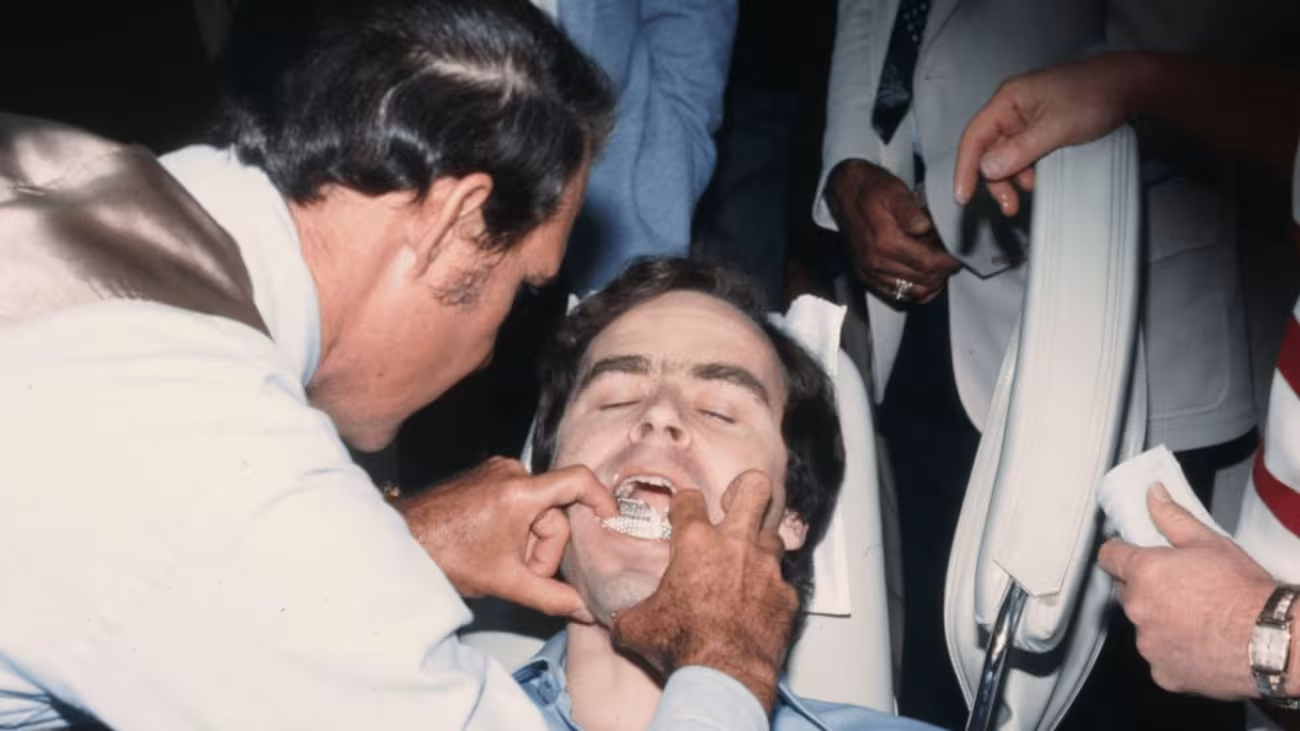
Photographs of serial killer Ted Bundy's body after his execution became a major controversy in February 1989, when the American tabloid Weekly World News published images showing his remains following his death in Florida's electric chair.
Bundy had been executed on January 24, 1989, at Florida State Prison in Raiford. The photographs appeared less than two weeks later, raising questions about how the images had been obtained and whether publishing pictures of a dead prisoner crossed ethical boundaries.
The publication defended its decision by describing the photographs as historically important. Florida officials, however, condemned the decision and questioned the commercialization of a notorious criminal's death.
Ted Bundy Was Executed in Florida's Electric Chair
Theodore Robert Bundy was executed on January 24, 1989, at Florida State Prison near Starke, Florida. He was 42 years old.
Bundy had been sentenced to death for the kidnapping, rape, and murder of 12-year-old Kimberly Leach in 1978. He had also received death sentences for the murders of two Florida State University students, Margaret Bowman and Lisa Levy.
His execution took place shortly after 7 a.m. in the prison's electric chair, popularly known as Old Sparky.
According to contemporary reporting by the Los Angeles Times, approximately 2,000 volts of electricity were applied during the procedure. Medical personnel subsequently checked his vital signs before a prison doctor pronounced him dead at 7:16 a.m.
Forty-two witnesses attended the execution, including journalists, law enforcement officials, and other authorized observers.
Bundy's death attracted enormous public attention. Hundreds of people gathered outside the prison, many celebrating the execution of a man responsible for numerous murders.
What Did Ted Bundy's Body Look Like After the Execution?
Following the execution, Bundy's body was transferred to a funeral director and transported to the medical examiner's office in Gainesville, Florida, for an autopsy.
Photographs published later by Weekly World News reportedly showed his body after the execution, including visible marks around his head and areas associated with the autopsy procedure.
The publication presented the images as authentic post-execution photographs. Its coverage included close-up pictures and descriptions of marks that it identified as electrode burns and surgical stitching.
These were not photographs of Bundy's murder victims or crime scenes. They were presented as images of Bundy's own remains after his execution and subsequent medical examination.
Weekly World News Publishes Ted Bundy's Death Photos
On February 6, 1989, Weekly World News published a series of photographs showing Bundy's corpse.
The newspaper's managing editor, Eddie Clontz, defended the publication, arguing that the images could serve as a deterrent to potential murderers.
He described the photographs as historically important and argued that publishing them could potentially discourage someone from committing similar crimes.
However, Clontz refused to disclose how the publication had obtained the pictures.
He also rejected suggestions that the photographs might be fake, insisting that readers would recognize their authenticity.
The decision generated immediate controversy because the images had not been released through an official public announcement by Florida prison authorities.
Florida Officials Question How the Photographs Were Obtained
One of the most controversial aspects of the publication was the uncertainty surrounding the photographs' origin.
Bob McMaster, a spokesperson for the Florida Department of Corrections, disputed the possibility that the photographs had been taken while Bundy's body remained in state custody.
He explained that the body had been transferred to a funeral director shortly after the execution for transportation to the medical examiner's office.
McMaster maintained that there was no way the photographs could have been taken while the body was under the department's control.
Florida Governor Bob Martinez also commented on the controversy. He noted that the photographs must have been taken after the body had left state custody.
However, the publication did not disclose the photographer or provide a detailed account of the images' chain of custody.
Consequently, contemporary reporting documented the publication's authenticity claims and the state's objections, but did not independently establish the complete circumstances in which the photographs were taken.
Florida's Attorney General Calls the Publication Sick
The publication attracted particularly strong criticism from Florida officials.
Attorney General Bob Butterworth described the use of the photographs as sick and criticized the decision to turn the execution into a commercial product.
He argued that publishing the images was in poor taste, even considering the severity of Bundy's crimes.
Governor Martinez similarly expressed concern about the commercialization of crime. However, he acknowledged that freedom of the press limited the government's ability to prevent a publication from printing the photographs.
The controversy therefore involved two competing arguments: the publisher's claim that the images had historical and deterrent value, and the state's concern that they exploited a death for commercial attention.
What Happened to Ted Bundy's Body After the Autopsy?
After the execution, Bundy's remains were transported to Gainesville for an autopsy and subsequently released to a funeral home.
He was later cremated. His ashes were scattered in the Cascade Range of Washington State, in accordance with instructions in his will.
The location was significant because Washington was one of the states associated with his series of murders during the 1970s.
Unlike many notorious criminals whose remains are buried in identifiable graves, Bundy left no conventional burial site for visitors.
Why Are Ted Bundy's Post-Execution Photos Still Discussed?
The photographs remain a subject of interest because they document an unusual chapter in the public history of the Bundy case: the commercial publication of images taken after a highly publicized execution.
They also illustrate how the media treated notorious criminals during an era when supermarket tabloids competed aggressively for readers through sensational stories and exclusive photographs.
The controversy raised questions that remain relevant today:
- Should photographs of executed prisoners be made publicly available?
- Does the historical value of an image justify publishing graphic material?
- Should media organizations profit from photographs of deceased individuals?
- Where should the boundaries of press freedom and human dignity be drawn?
In Bundy's case, the photographs were particularly controversial because their publication involved a person whose crimes had already attracted extraordinary public attention.
Conclusion
Ted Bundy's post-execution photographs became a national controversy after Weekly World News published images of his corpse on February 6, 1989.
The publication defended the photographs as historically important and potentially useful as a deterrent. Florida officials strongly criticized the decision, questioning how the images had been obtained and describing their commercial publication as being in poor taste.
Bundy had been executed on January 24, 1989, and his body was subsequently examined, released to a funeral home, and cremated. His ashes were scattered in Washington State's Cascade Range.
More than the photographs themselves, the controversy remains an example of the difficult questions surrounding crime reporting, graphic imagery, press freedom, and the commercialization of death.