
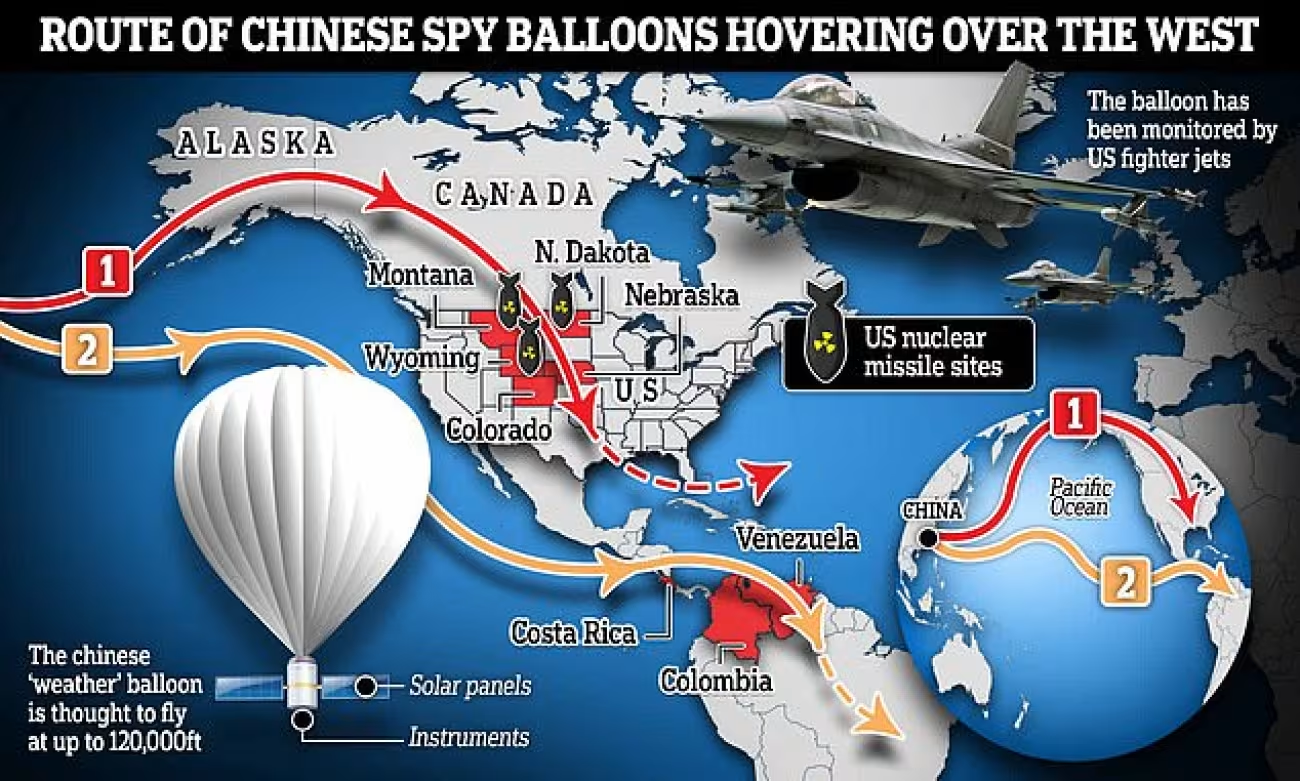
The Chinese spy balloon incident became a major diplomatic confrontation between the United States and China in February 2023 after an enormous high-altitude balloon traveled across North American airspace, including areas near sensitive American military installations. The United States identified the object as a Chinese surveillance platform, while Beijing insisted it was a civilian research airship that had accidentally deviated from its planned course.
On February 4, 2023, a US Air Force F-22 Raptor shot down the balloon over the Atlantic Ocean near Myrtle Beach, South Carolina, following an order from President Joe Biden. The aircraft had traveled across Alaska, Canada and the continental United States before reaching the coast.
The incident triggered a significant diplomatic dispute. Secretary of State Antony Blinken postponed a planned visit to Beijing, Chinese officials criticized the American military response, and Washington imposed export restrictions on companies associated with China's high-altitude balloon program.
However, subsequent intelligence assessments introduced an important distinction between the balloon's capabilities and what it actually accomplished. In June 2023, the Pentagon announced that its assessment was that the balloon had not collected intelligence while flying over the United States, despite possessing surveillance capabilities.
A detailed retrospective published by the Carnegie Endowment for International Peace in March 2026 further suggested that the balloon's route into American airspace was likely accidental, even though Chinese military operators may have intended to exploit the unexpected opportunity to observe sensitive sites.
The incident remains a significant example of how military surveillance, airspace sovereignty and failures in diplomatic communication can escalate tensions between competing world powers.
Chinese Spy Balloon Incident: Key Facts
| Incident | Chinese high-altitude balloon over North America |
| Country of origin | China |
| First detected near Alaska | January 28, 2023 |
| Public disclosure | February 2, 2023 |
| Shootdown date | February 4, 2023 |
| Shootdown location | Atlantic Ocean near Myrtle Beach, South Carolina |
| Aircraft used | US Air Force F-22 Raptor |
| Weapon | AIM-9X Sidewinder missile |
| Approximate operating altitude | 60,000 feet or higher |
| US assessment | High-altitude intelligence surveillance platform |
| China's explanation | Civilian meteorological research airship blown off course |
| Recovery completed | February 16, 2023 |
| Public intelligence finding | Pentagon assessed in June 2023 that no intelligence was collected over the US |
| Principal diplomatic consequence | Postponement of Antony Blinken's Beijing visit |
How the Chinese Balloon Entered American Airspace
The US military first detected the high-altitude balloon near Alaska on January 28, 2023. American and Canadian authorities subsequently tracked it as it traveled across North America.
After passing through Alaskan airspace, the balloon moved over Canada before entering the continental United States near Idaho on January 31.
It later traveled over Montana, attracting particular concern because of the state's military infrastructure, including Malmstrom Air Force Base, which supports American intercontinental ballistic missile operations.
The Pentagon publicly acknowledged the balloon on February 2, confirming that it had been monitoring the object for several days.
As photographs circulated online, the unusual aircraft became a major international news story. Its enormous size and apparent ability to remain above American territory raised questions about national security, surveillance capabilities and the effectiveness of US air defenses.
Why Montana Raised National Security Concerns
Montana is home to important components of the United States' nuclear deterrent, including missile facilities associated with Malmstrom Air Force Base.
The balloon's proximity to these installations raised concerns that it might have been capable of collecting information about military communications, radar activity or other sensitive infrastructure.
US officials believed the aircraft carried surveillance equipment, including systems potentially capable of gathering electronic signals.
However, the presence of such equipment did not establish that sensitive information had actually been collected or successfully transmitted to China.
Was the Chinese Balloon Really a Spy Aircraft?
The central dispute concerned the balloon's intended purpose.
American authorities identified it as part of a Chinese high-altitude surveillance program associated with the People's Liberation Army. China rejected that characterization and maintained that the aircraft was intended primarily for civilian research.
The United States' Position
US officials stated that the balloon carried specialized equipment inconsistent with a conventional weather balloon.
According to information released by the State Department and Pentagon, the platform included solar panels, antennas and surveillance-related instruments.
The United States also assessed that China operated a broader high-altitude balloon program capable of collecting intelligence across multiple continents.
During February 2023, the White House described the program as connected to the Chinese military and said that similar balloons had been observed operating over numerous countries.
These findings led Washington to characterize the aircraft as a surveillance platform rather than an ordinary meteorological device.
China's Explanation
China's Ministry of Foreign Affairs acknowledged on February 3, 2023, that the airship originated in China.
However, the ministry described it as a civilian aircraft used for research, mainly meteorological purposes.
Chinese officials explained that strong westerly winds and limited steering capabilities had caused the aircraft to deviate significantly from its intended route.
Beijing expressed regret over the unintended entry into American airspace but rejected the allegation that the balloon had been deliberately sent to conduct espionage over the continental United States.
Following its destruction, China accused Washington of overreacting and using military force unnecessarily against a civilian aircraft.
Why Did the United States Wait Before Shooting Down the Balloon?
The decision not to shoot down the balloon immediately became one of the most controversial aspects of the incident.
President Biden instructed the military to bring down the aircraft, but military advisers recommended waiting until it reached a location where falling debris would pose less danger to civilians.
The balloon was operating at an altitude above commercial aircraft routes and carried a large equipment payload.
Destroying it over populated areas could have caused debris to fall across a substantial distance, potentially injuring people or damaging property.
The administration therefore decided to monitor the balloon as it crossed the country and destroy it over water.
Defense officials also stated that the military took precautions to reduce the balloon's ability to gather information while passing sensitive installations.
The February 4 Shootdown Near South Carolina
On February 4, 2023, the balloon reached the Atlantic coast near Myrtle Beach, South Carolina.
A US Air Force F-22 Raptor fired an AIM-9X Sidewinder air-to-air missile, destroying the balloon above American territorial waters.
The operation was coordinated through US Northern Command and the North American Aerospace Defense Command (NORAD), with Canadian cooperation during the broader tracking operation.
Defense Secretary Lloyd Austin described the action as a response to an unacceptable violation of American sovereignty.
Chinese authorities strongly criticized the operation, maintaining that the aircraft had not presented a direct military threat.
What Did Investigators Find in the Balloon's Wreckage?
Following the shootdown, the US Navy, Coast Guard and Federal Bureau of Investigation conducted a recovery operation off the South Carolina coast.
The mission involved retrieving balloon fabric, structural components, electronics and equipment that had fallen into the Atlantic Ocean.
The FBI assumed responsibility for examining the recovered material at its laboratory in Quantico, Virginia, with assistance from other government agencies.
Investigators sought to establish the equipment's origins, technical specifications, operational capabilities and potential intelligence functions.
Recovery operations concluded on February 16, 2023, after authorities retrieved substantial portions of the debris.
Did the Balloon Contain American-Made Technology?
In June 2023, media investigations reported that the balloon incorporated commercially available American-made components alongside more specialized Chinese equipment.
ABC News reported that a US official had confirmed the presence of American off-the-shelf technology.
The findings raised questions about the international availability of electronics that could be incorporated into foreign surveillance platforms.
However, the use of commercially available American components does not automatically establish that the technology was illegally exported or obtained through espionage.
Details of the complete technical analysis have not been fully disclosed publicly.
Did the Chinese Spy Balloon Actually Collect Intelligence?
One of the most important developments came on June 29, 2023, when the Pentagon publicly addressed the results of its assessment.
Brigadier General Pat Ryder, then the Pentagon's press secretary, stated that the Defense Department assessed that the balloon had not collected intelligence while traveling over American territory.
He also explained that US authorities had taken measures to reduce the risk of intelligence collection during the aircraft's journey.
The announcement was significant because earlier media reporting had suggested that the balloon might have collected information from military installations and potentially transmitted it to China.
The Pentagon's later public assessment did not substantiate those claims.
Surveillance Capability Does Not Mean Successful Intelligence Collection
A distinction is necessary between three separate questions:
- Was the platform capable of surveillance? US authorities assessed that it was equipped with intelligence collection capabilities.
- Did it collect intelligence over the United States? The Pentagon's June 2023 assessment was that it did not.
- Why was it unsuccessful? US officials cited countermeasures but did not publicly establish exactly how much each precaution contributed.
These findings do not independently prove China's assertion that the aircraft was purely civilian. They establish that the American government distinguished between the platform's intended capabilities and the information it actually obtained.
2026 Assessment: Was the Balloon's Flight Path Accidental?
A more detailed interpretation emerged in March 2026 through a Carnegie Endowment for International Peace study examining the Biden administration's China strategy.
Drawing on interviews and historical material, the study concluded that the balloon's unusual route into American airspace was likely unintended.
According to the analysis, the aircraft was launched from Hainan Island and may originally have been intended to travel toward Guam, where the United States maintains important military facilities.
Unusual atmospheric conditions reportedly pushed the balloon northward toward Alaska and eventually into the continental United States.
However, the research also suggested that Chinese military operators continued the mission and were prepared to take advantage of opportunities to gather intelligence near American nuclear missile facilities.
This interpretation helps explain why two apparently conflicting conclusions may both contain elements of truth: the flight route may have been unplanned, while the aircraft itself may still have been designed for intelligence gathering.
It remains a research-based reconstruction rather than a complete, publicly declassified account of the Chinese operators' instructions.
How the Balloon Incident Damaged US-China Relations
The confrontation occurred during a sensitive period in relations between Washington and Beijing.
Both governments were already managing disagreements over Taiwan, international trade, technology restrictions, military activities in the Indo-Pacific and China's relationship with Russia.
President Biden and Chinese President Xi Jinping had met in Bali in November 2022 and agreed to maintain diplomatic communication.
The balloon incident disrupted efforts to stabilize their relationship.
Antony Blinken Postpones His China Visit
Secretary of State Antony Blinken had been scheduled to travel to Beijing in February 2023 for high-level discussions with Chinese officials.
However, on February 3, the State Department announced that the visit would be postponed.
Blinken told China's senior foreign policy official Wang Yi that the balloon's presence violated American sovereignty and undermined the purpose of the planned diplomatic meetings.
The postponement became one of the clearest examples of the diplomatic consequences of the incident.
China Condemns the American Military Response
China's Ministry of Foreign Affairs issued a statement on February 5 criticizing the decision to shoot down the aircraft.
Beijing argued that the United States had used excessive force against a civilian airship whose unintended entry had already been acknowledged.
Chinese officials also maintained that the incident should have been handled through professional diplomatic communication.
The disagreement further reduced trust between the two governments at a time when military communication channels were already strained.
Washington Imposes Restrictions on Chinese Aerospace Companies
On February 10, 2023, the US Department of Commerce placed six Chinese entities on its Entity List for activities associated with military aerospace programs, including high-altitude balloons.
The restrictions increased government oversight of exports involving the designated companies and limited their ability to obtain certain American technologies without authorization.
The response continued beyond the immediate crisis.
On May 9, 2024, the Commerce Department announced additional restrictions on 37 Chinese entities, including 11 associated with China's high-altitude balloon program.
These actions demonstrated that the incident had consequences for export controls and technology policy even after the initial diplomatic dispute subsided.
Did US-China Diplomatic Relations Recover?
Although the confrontation caused a temporary setback, both governments eventually resumed senior-level communication.
Blinken traveled to Beijing on June 18–19, 2023, holding meetings with President Xi Jinping and other senior Chinese officials.
In November 2023, Biden and Xi met again in California, where they discussed managing competition and restoring communication between their military organizations.
The relationship remained complicated, but the meetings demonstrated that both sides recognized the risks of allowing an isolated security incident to permanently undermine diplomatic engagement.
Military communication subsequently resumed in several forms during 2024, although broader disagreements over Taiwan, technology and regional security continued.
Why the Incident Changed North American Air Defense
The balloon incident exposed limitations in the detection of high-altitude, slow-moving aerial objects.
Traditional air defense systems are designed primarily to identify aircraft and missiles presenting military threats.
Some balloons can be difficult to detect consistently because they move slowly, operate at unusual altitudes and may have radar characteristics that differ from conventional aircraft.
Following the incident, NORAD adjusted its monitoring practices and increased scrutiny of objects that previously might not have been prioritized.
What About the Three Other Objects Shot Down in February 2023?
Between February 10 and February 12, US fighter aircraft shot down three additional unidentified aerial objects over Alaska, Canada's Yukon Territory and Lake Huron.
These objects generated considerable speculation about the possibility of a larger Chinese surveillance operation.
However, the Biden administration subsequently stated that there was no evidence connecting the three objects to China's military surveillance program.
Intelligence officials assessed that they were most likely associated with private companies, recreational activities or scientific research.
They should therefore not be described as three additional confirmed Chinese spy balloons.
Timeline of the Chinese Spy Balloon Crisis
| Date | Event |
|---|---|
| January 28, 2023 | US defense authorities detect a Chinese high-altitude balloon approaching American airspace near Alaska. |
| January 31, 2023 | The balloon enters the continental United States after passing through Canada. |
| February 2, 2023 | The Pentagon publicly confirms it is tracking a suspected Chinese surveillance balloon. |
| February 3, 2023 | China describes the object as a civilian research airship. Antony Blinken postpones his Beijing visit. |
| February 4, 2023 | An American F-22 shoots down the balloon near South Carolina. |
| February 10, 2023 | Washington imposes export restrictions on six Chinese entities associated with military aerospace activities. |
| February 16, 2023 | Recovery operations conclude and retrieved components are transferred for analysis. |
| June 18–19, 2023 | Blinken visits Beijing to resume senior diplomatic discussions. |
| June 29, 2023 | The Pentagon states that the balloon was assessed not to have collected intelligence over the United States. |
| November 15, 2023 | Biden and Xi meet in California and discuss stabilizing bilateral relations. |
| May 9, 2024 | The US Commerce Department restricts 11 additional Chinese entities linked to high-altitude balloon activities. |
| March 2026 | Carnegie Endowment research provides a detailed retrospective suggesting an accidental flight path and possible opportunistic military surveillance intentions. |
What the Chinese Spy Balloon Incident Means for International Security
The incident highlighted several weaknesses in the way major powers manage intelligence gathering and military competition.
First, high-altitude balloons remain relevant surveillance platforms even in an era dominated by satellites and advanced unmanned aircraft. Their ability to operate slowly over specific areas can provide opportunities for sustained observation.
Second, detecting an aircraft does not automatically establish its full capabilities or intentions. Governments must distinguish between possible threats, confirmed intelligence activity and the risks associated with responding militarily.
Third, diplomatic communication becomes especially important when unexpected military incidents occur. Delays in communication or disagreements about an incident's purpose can quickly intensify political pressure and increase the possibility of miscalculation.
Finally, the incident demonstrated how a single security controversy can influence broader policies involving export controls, intelligence cooperation, air defense and diplomatic engagement.
Conclusion: What We Know About the Chinese Spy Balloon
The Chinese spy balloon incident of February 2023 became a defining confrontation in US-China relations after a high-altitude aircraft crossed North America and was destroyed by an American F-22 near South Carolina.
Washington identified the balloon as part of a Chinese military-linked surveillance program, while Beijing maintained that it was a civilian research aircraft blown off course.
Subsequent American assessments introduced important qualifications. Although the balloon possessed intelligence collection capabilities, the Pentagon concluded in June 2023 that it had not collected information while flying over the United States.
A 2026 research assessment further suggested that its route toward the continental United States may have been accidental, even if Chinese military operators subsequently considered exploiting the unexpected flight path.
The incident nevertheless had lasting consequences. It disrupted diplomatic engagement, prompted new restrictions on Chinese aerospace companies and exposed challenges in detecting high-altitude aircraft.
Its broader lesson is that technological surveillance and national security cannot be separated from diplomacy. Without reliable communication and clear assessments of potential threats, even an aircraft that causes no direct physical damage can become a major international crisis.