
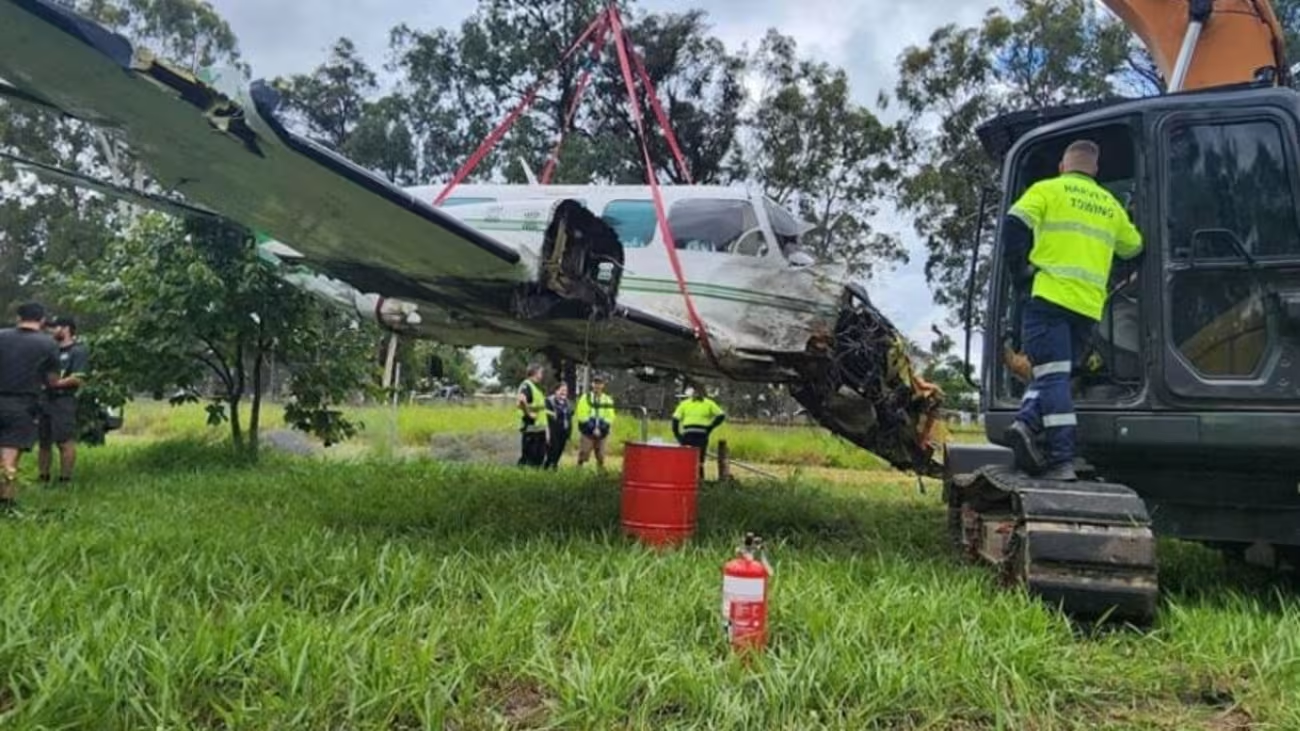
A female pilot narrowly escaped serious injury after a light aircraft crashed near a railway line in Hillcrest, south of Brisbane, Queensland, on Good Friday, April 7, 2023. The aircraft made an emergency landing in a railway corridor, struck a fence, and collided with several trees before coming to a stop. Despite extensive damage to the cockpit and fuselage, the pilot managed to escape from the wreckage with only minor injuries.
Emergency services were called to Lollard Street shortly after 6:00 a.m. following reports that a small aircraft had crashed near residential properties. Neighbours who heard the impact rushed outside and helped the injured woman move away from the wreckage and reach safety.
The incident initially attracted attention because of the remarkable survival of the pilot, particularly given the extent of the aircraft damage and the proximity of nearby houses. However, a subsequent investigation by the Australian Transport Safety Bureau (ATSB) revealed that the crash was the result of fuel starvation, incorrect engine troubleshooting, and fatigue.
The aircraft was a twin-engine Piper PA-31-350 Chieftain operated by Air Link. Contrary to some early descriptions of the aircraft as a medical transport plane, the ATSB's final report confirmed that it was conducting a freight-only charter flight and had no passengers on board.
What Happened in the Hillcrest Light Aircraft Crash?
The accident occurred at approximately 6:05 a.m. on April 7, 2023, in Hillcrest, a suburb south of Brisbane in Queensland, Australia.
The aircraft was approaching Archerfield Airport when the pilot experienced a loss of engine power. The problem initially affected the right engine before the left engine also began malfunctioning.
With both engines experiencing power problems, the aircraft could no longer maintain sufficient altitude to reach its intended destination.
The pilot eventually declared an emergency and informed air traffic control that an off-airport forced landing was necessary.
With limited suitable landing locations available, the pilot selected a railway corridor beside a train line in Hillcrest. The decision allowed the aircraft to avoid nearby residential properties and other potentially dangerous obstacles.
During the landing, the aircraft's left wing struck a wire fence before the plane collided with several trees. The impact caused substantial damage to the fuselage and wings.
Despite the violent landing, the pilot survived and was able to leave the aircraft through its rear door.
Woman Pilot Escapes With Minor Injuries
Queensland emergency services responded to the accident shortly after receiving reports of the crash.
According to Queensland Ambulance Service's Metro South acting operations supervisor, James Van den Bogert, emergency crews arrived approximately 10 minutes after receiving the initial report.
A Rescue 500 helicopter was also deployed to the scene.
When paramedics reached the aircraft, they found that the pilot had already managed to escape from the wreckage and move away from the damaged plane.
She was conscious, able to walk, and communicating with emergency personnel.
Her injuries included bruising to her lower limbs and several cuts to her face. Paramedics considered her condition relatively minor given the severity of the accident.
She was subsequently transported to hospital for medical assessment.
Van den Bogert described the outcome as extremely fortunate, considering the extensive damage visible around the aircraft's cockpit and engine.
Neighbours Rush to Help After Hearing the Aircraft Crash
Residents living near the railway corridor were among the first people to assist the pilot after the accident.
One neighbour, Stuart Davies, said he was awake when he heard an unusually loud crashing noise outside his home. Initially, he thought the sound might have come from a train carriage or another railway-related incident.
After going outside, he discovered that a small aircraft had crashed in a nearby grassy area.
Davies climbed over a fence and approached the wreckage. He found the pilot outside the aircraft and helped support her as she moved away from the crash site.
He also helped her cross the railway tracks and reach a safer location.
Speaking to ABC News, Davies said he was surprised that the woman had escaped without more serious injuries, particularly because the front section of the aircraft had been badly damaged.
Another resident, Jane Littlejohns, said she witnessed Davies helping the pilot and initially feared that the woman might have been seriously injured.
Neighbour Heidi Dunstan also described being shocked by the crash and expressed relief that the pilot had survived.
The quick assistance provided by local residents helped the pilot move away from the damaged aircraft before emergency responders completed their assessment.
Where Did the Aircraft Crash?
The aircraft came down on Lollard Street in Hillcrest, approximately 11 kilometres south of Archerfield Airport.
The crash site was located beside a railway corridor and close to residential properties.
According to the ATSB investigation, the pilot selected the location because there were very few suitable landing areas available during the emergency.
Leaving the landing gear and flaps retracted helped minimize aerodynamic drag and gave the aircraft a better chance of reaching the selected landing area.
Although the aircraft struck a fence and several trees, the controlled touchdown helped reduce the risk of more serious consequences.
The pilot's decision also prevented the aircraft from crashing directly into nearby homes.
What Aircraft Was Involved in the Hillcrest Crash?
The aircraft involved was a Piper PA-31-350 Chieftain, a twin-engine light aircraft commonly used for charter, freight, and other commercial aviation operations.
It carried the Australian registration VH-HJE and was operated by Air Link Pty Limited.
Manufactured in 1978, the aircraft was equipped with two turbocharged piston engines and had a maximum usable fuel capacity of approximately 690 litres.
Aircraft Details
| Aircraft Manufacturer | Piper Aircraft Corporation |
|---|---|
| Aircraft Model | PA-31-350 Chieftain |
| Registration | VH-HJE |
| Year Manufactured | 1978 |
| Operator | Air Link Pty Limited |
| Aircraft Type | Twin-engine light aircraft |
| Engines | Two Lycoming TIO-540 turbocharged piston engines |
| Flight Purpose | Freight charter |
| Number of Occupants | One pilot |
| Accident Date | April 7, 2023 |
| Accident Location | Hillcrest, Queensland, Australia |
The aircraft was returning from Sydney's Bankstown Airport to Brisbane's Archerfield Airport when the accident occurred.
It was not carrying passengers or medical patients during the flight. The aircraft was transporting freight as part of a commercial charter operation.
Why Did the Plane Crash? ATSB Investigation Reveals Fuel Starvation
Although early reports focused on the possibility of a mechanical problem, the final ATSB investigation established a different explanation.
Released on July 19, 2024, the report concluded that both engines lost power because the aircraft's auxiliary fuel supply had been consumed while the main fuel tanks were not selected as required.
Investigators found no evidence of mechanical engine failure that could explain the loss of power.
The investigation identified several contributing factors involving fuel management, pilot decision-making, and fatigue.
1. The Main Fuel Tanks Were Probably Not Selected Before Descent
The Piper PA-31-350 had two main fuel tanks and two auxiliary fuel tanks.
Under the aircraft manufacturer's operating procedures, the main tanks were required to be selected during take-off, climb, and descent. The auxiliary tanks were intended primarily for use during level cruise flight.
According to the pilot, the fuel selectors had been changed from the auxiliary tanks back to the main tanks before beginning the descent toward Brisbane.
However, investigators examined the remaining fuel recovered from the aircraft after the accident and compared it with calculated fuel consumption.
The evidence indicated that the pilot had probably not completed the required tank selection.
As a result, the aircraft continued using the auxiliary fuel supply until both engines experienced fuel starvation.
2. The Pilot Misdiagnosed the Engine Problems
When the right engine first began losing power, the pilot believed that it was experiencing a partial power failure rather than complete fuel starvation.
The pilot attempted several troubleshooting procedures, including adjusting the mixture controls, operating the fuel pumps, and changing fuel selector positions.
However, the main fuel tank was not selected to restore the fuel supply.
The right propeller was also not feathered, a procedure that would have reduced aerodynamic drag following a complete engine failure.
Because the aircraft continued experiencing excessive drag from the malfunctioning right engine, the remaining engine could not maintain altitude.
Approximately 12 minutes later, the left engine also began running roughly and losing power.
At that point, the pilot had little opportunity to recover the aircraft and began searching for a suitable emergency landing location.
3. Pilot Fatigue Played an Important Role
One of the most significant findings concerned the pilot's working and sleeping schedule.
The ATSB reviewed the pilot's sleep history and concluded that the pilot was likely experiencing fatigue at a level capable of affecting performance.
By the time the aircraft crashed, the pilot had reportedly been awake for almost 20 hours.
The pilot had also undertaken outside employment during the day before operating the overnight flight.
Investigators considered it likely that fatigue affected the pilot's ability to remember the correct fuel-selection procedures and troubleshoot the engine problems effectively.
The findings highlighted the importance of adequate rest before operating aircraft during normal sleeping hours.
How the Pilot Managed to Survive the Crash
Despite the extensive damage, the pilot's decision-making during the final stages of the flight helped prevent an even more serious accident.
After both engines began malfunctioning, the aircraft was losing altitude rapidly and could no longer reach Archerfield Airport.
The pilot therefore needed to identify an alternative landing location while maintaining sufficient airspeed to retain control.
The railway corridor provided a relatively open area compared with the surrounding residential streets and buildings.
The pilot also kept the landing gear and flaps retracted to reduce drag and preserve the aircraft's remaining performance.
According to the ATSB, the selected landing location minimized the potential for damage and injury to people on the ground, while the controlled touchdown maximized the pilot's chances of survival.
Although the aircraft subsequently hit a fence and several trees, the pilot was able to escape through the rear door.
Air Link Introduces Changes After the Aircraft Accident
Following the investigation, aircraft operator Air Link implemented several safety measures intended to reduce the possibility of similar incidents.
The company issued a notice to its pilots highlighting the importance of recognizing and managing fuel starvation.
It also reviewed pilot training to improve understanding of engine power-loss situations and the procedures required to respond to them.
Additional changes included reviewing fuel policies and flight-planning software to ensure that the information provided to pilots was consistent.
The company's Fatigue Management Manual was also updated to address external employment and establish restrictions relating to working hours and duty periods.
These measures were intended to improve fuel management, reduce fatigue-related risks, and strengthen operational safety.
What the Hillcrest Plane Crash Teaches About Aviation Safety
The Hillcrest accident demonstrates how multiple operational problems can combine to create a serious aviation emergency.
Although the aircraft was equipped with two engines, the failure to maintain the correct fuel supply eventually caused both engines to lose power.
The investigation also showed that a pilot's ability to respond effectively during an emergency can be affected by fatigue and incorrect interpretation of aircraft instruments.
Several important aviation safety lessons emerged from the incident:
- Fuel management: Pilots must follow the aircraft manufacturer's fuel-selection procedures and verify tank settings during each phase of flight.
- Emergency procedures: Correctly identifying engine failure and following the appropriate checklist can prevent a developing problem from becoming catastrophic.
- Fatigue management: Adequate rest is essential for maintaining concentration, decision-making, and operational performance.
- Aircraft monitoring: Operators need effective systems for monitoring fuel consumption and identifying discrepancies in flight planning.
- Emergency landing decisions: Selecting a suitable landing location can reduce risks to both aircraft occupants and people on the ground.
The ATSB emphasized that fuel management and fatigue are shared responsibilities between pilots and aircraft operators.
Conclusion
The Hillcrest light aircraft crash on Good Friday, April 7, 2023, could have ended in tragedy. A female pilot survived after a Piper PA-31-350 Chieftain lost engine power and made an emergency landing beside a railway line south of Brisbane.
Although the aircraft suffered substantial damage after striking a fence and several trees, the pilot escaped with only minor injuries. Quick assistance from nearby residents and the controlled emergency landing contributed to the fortunate outcome.
The subsequent ATSB investigation revealed that fuel starvation, incorrect fuel-tank selection, engine troubleshooting errors, and pilot fatigue contributed to the accident. Investigators found no mechanical failure that would have caused the engines to lose power.
The incident ultimately became an important aviation safety case, demonstrating why proper fuel management, pilot rest, and strict adherence to emergency procedures are essential in commercial aircraft operations.