
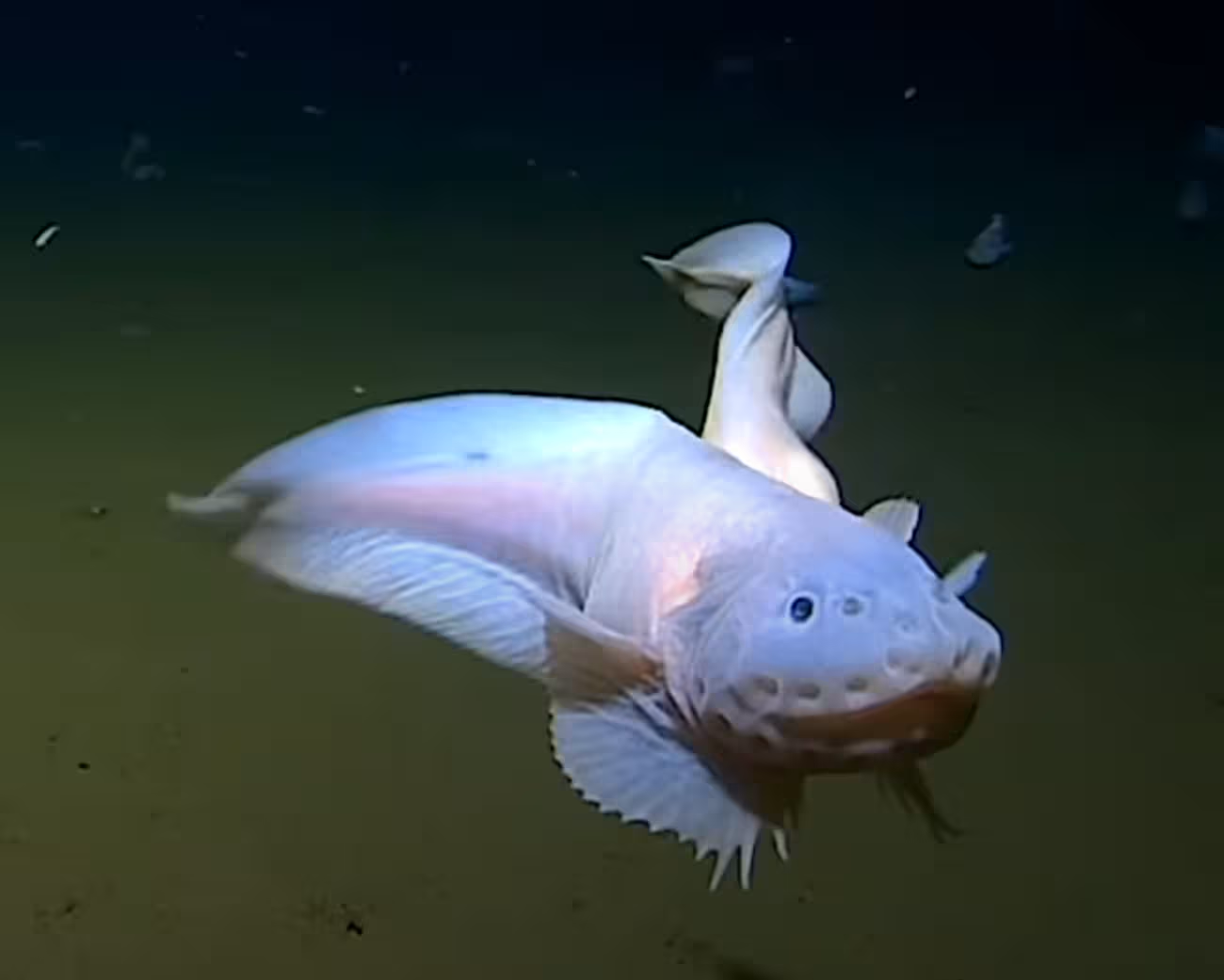
Thousands of metres beneath the ocean surface, where sunlight never reaches and pressure becomes powerful enough to challenge the survival of most organisms, an extraordinary fish continues to thrive. It is the snailfish, a deep-sea animal that has become one of the most remarkable discoveries in modern marine biology.
In 2022, researchers filmed a snailfish at an astonishing depth of 8,336 metres in the Izu-Ogasawara Trench near Japan. The observation, published in 2023, established a new record for the deepest fish ever filmed alive.
Unlike the powerful predators often associated with the deep ocean, snailfish have soft bodies, relatively large heads, and delicate appearances. Their survival in one of Earth's most extreme environments offers scientists important insights into the limits of vertebrate life.
The Deepest Fish Ever Recorded
The record-breaking observation occurred during a joint scientific expedition involving researchers from the University of Western Australia and the Tokyo University of Marine Science and Technology.
The team deployed specialized deep-sea camera systems in the Izu-Ogasawara Trench, part of the western Pacific Ocean. At 8,336 metres below the surface, their cameras captured a juvenile snailfish swimming near the ocean floor.
The fish was tentatively identified as Pseudoliparis, possibly Pseudoliparis belyaevi or an undescribed local species. Because researchers did not physically capture the individual, its precise species identity could not be confirmed.
The discovery surpassed the previous widely reported observation of a Mariana snailfish filmed at approximately 8,178 metres in the Mariana Trench.
It also demonstrated that suitable conditions for deep-sea fish may extend farther down in certain ocean trenches than previously documented.
What Makes Snailfish Different?
Snailfish belong to the family Liparidae, a group of marine fishes found in environments ranging from relatively shallow coastal waters to the deepest ocean trenches.
Despite their name, these animals are not related to snails. Their common name comes from their soft, somewhat gelatinous appearance and the small suction-disc structure found in some species.
Typical characteristics include:
- Soft bodies: Their relatively flexible bodies help them function under extreme pressure.
- Large heads: Many species have disproportionately large heads and tapered bodies.
- Small eyes: Their vision is adapted to environments with extremely limited light.
- Reduced scales: Many deep-sea species have little or no conventional external scaling.
- Specialized fins: Their fins help them move close to the seabed and navigate their deep-water habitats.
Not every snailfish has the same appearance. The family contains many species with different body shapes, sizes, and adaptations depending on their environment.
How Can Snailfish Survive Crushing Ocean Pressure?
At 8,000 metres below the surface, water pressure exceeds 800 times the atmospheric pressure experienced at sea level.
For most familiar vertebrates, these conditions would severely disrupt normal biological processes. Deep-sea snailfish, however, possess several adaptations that allow their cells and organs to function under enormous pressure.
1. Flexible Skeletons and Reduced Hard Structures
Deep-sea snailfish generally have lightweight, flexible skeletons rather than the heavily mineralized structures found in many other fishes.
Their bodies are not designed to resist pressure through rigid external armor. Instead, their anatomy is suited to an environment where pressure acts relatively evenly across the body.
2. Specialized Proteins and Cell Chemistry
Pressure can interfere with the structure and function of proteins, potentially disrupting essential cellular processes.
Research suggests that deep-sea fishes use specialized biochemical adaptations, including the accumulation of pressure-protective molecules such as trimethylamine N-oxide (TMAO).
TMAO helps stabilize proteins and counteracts some of the disruptive effects of pressure. However, its concentration increases with depth, and this may contribute to an upper limit on how deep bony fishes can survive.
3. No Conventional Swim Bladder
Many familiar fish use a gas-filled swim bladder to regulate buoyancy.
At extreme depths, maintaining a gas-filled structure becomes difficult because gas is highly compressible under enormous pressure.
Deep-sea snailfish generally lack a conventional gas-filled swim bladder. Their buoyancy and movement rely on other physical and physiological mechanisms.
The Mariana Snailfish: A Deep-Sea Specialist
One of the best-studied species is the Mariana snailfish, scientifically known as Pseudoliparis swirei.
First formally described in 2017, this species inhabits the Mariana Trench in the western Pacific Ocean. Researchers collected specimens at depths ranging from approximately 6,898 to 7,966 metres.
The species was named after Herbert Swire, an officer aboard HMS Challenger during the historic 1872–1876 expedition that helped establish modern oceanography.
Scientists have studied its anatomy, reproduction, genetics, and ability to survive under extreme pressure. Its discovery provided valuable evidence that vertebrate animals can inhabit environments far deeper than most researchers once expected.
Why the Deepest Parts of the Ocean Are Called the Hadal Zone
The hadal zone refers to the deepest parts of the ocean, generally beginning at approximately 6,000 metres and extending down into the deepest ocean trenches.
Its name comes from Hades, the ancient Greek underworld, reflecting the extreme and largely inaccessible environment found at these depths.
Several characteristics define this environment:
- Permanent darkness: Sunlight cannot penetrate to these depths.
- Extreme pressure: Pressure increases by approximately one atmosphere for every 10 metres of seawater.
- Low temperatures: Water temperatures are generally close to freezing.
- Limited food: Organisms depend on organic material sinking from shallower waters and other localized food sources.
- Geological isolation: Deep trenches create distinct habitats that can support geographically isolated animal populations.
Despite these conditions, the hadal zone supports a surprisingly diverse ecosystem, including amphipods, sea cucumbers, worms, microorganisms, and specialized fishes.
Can Fish Survive Deeper Than 8,336 Metres?
Scientists believe there may be a physiological boundary limiting how deep bony fishes can live.
Research has suggested that the combination of pressure and temperature creates increasingly difficult conditions below approximately 8,200 to 8,400 metres.
One important factor is the biochemical balance required to keep proteins functioning correctly. As pressure increases, organisms need greater concentrations of protective molecules such as TMAO.
However, this adaptation has its own limits. The increasing concentration of TMAO can disrupt other biological processes, potentially making survival impossible beyond a certain depth.
The 8,336-metre snailfish observation falls remarkably close to this proposed boundary.
It remains possible that future expeditions will discover fish living slightly deeper. However, current evidence suggests that the deepest trenches may represent the practical limit for vertebrate life in the ocean.
How Scientists Explore These Extreme Depths
Studying snailfish requires specialized equipment capable of operating under enormous pressure.
Researchers commonly use remotely operated vehicles, autonomous underwater systems, and free-falling landers equipped with cameras and baited traps.
These landers descend to the seabed, where they record animal activity and sometimes collect specimens before returning to the surface.
During the 2022 expedition, scientists used specialized lander systems to observe fish at depths exceeding 8,000 metres. The equipment allowed them to document animals that would otherwise be extremely difficult to study.
Such technologies are improving the understanding of deep-sea ecosystems and helping researchers investigate how marine animals adapt to extreme environments.
New Research Reveals How Mariana Snailfish Swim
Research published in 2026 has provided another perspective on the behavior of deep-sea snailfish.
Scientists analyzed underwater video of Pseudoliparis swirei recorded at nearly 7,000 metres in the Mariana Trench.
Using computer vision and three-dimensional tracking techniques, researchers reconstructed the swimming trajectories of individual fish.
The study provided new information about how these animals move through their natural environment, rather than relying exclusively on specimens collected from deep-sea traps.
This development is important because observing living animals can reveal behaviors that cannot easily be understood through laboratory examination alone.
Conclusion
Snailfish are among the most extraordinary vertebrates on Earth. Their ability to survive at depths exceeding 8,000 metres demonstrates how life can adapt to environments that once seemed impossible for complex animals to inhabit.
The record-breaking observation of a snailfish at 8,336 metres in the Izu-Ogasawara Trench represents a major achievement in marine exploration. Meanwhile, continued research into the Mariana snailfish is revealing more about the biology and behavior of animals living in the hadal zone.
Although the deepest ocean remains difficult to explore, snailfish remind us that some of the most remarkable discoveries about life on Earth are still waiting beneath the surface.