
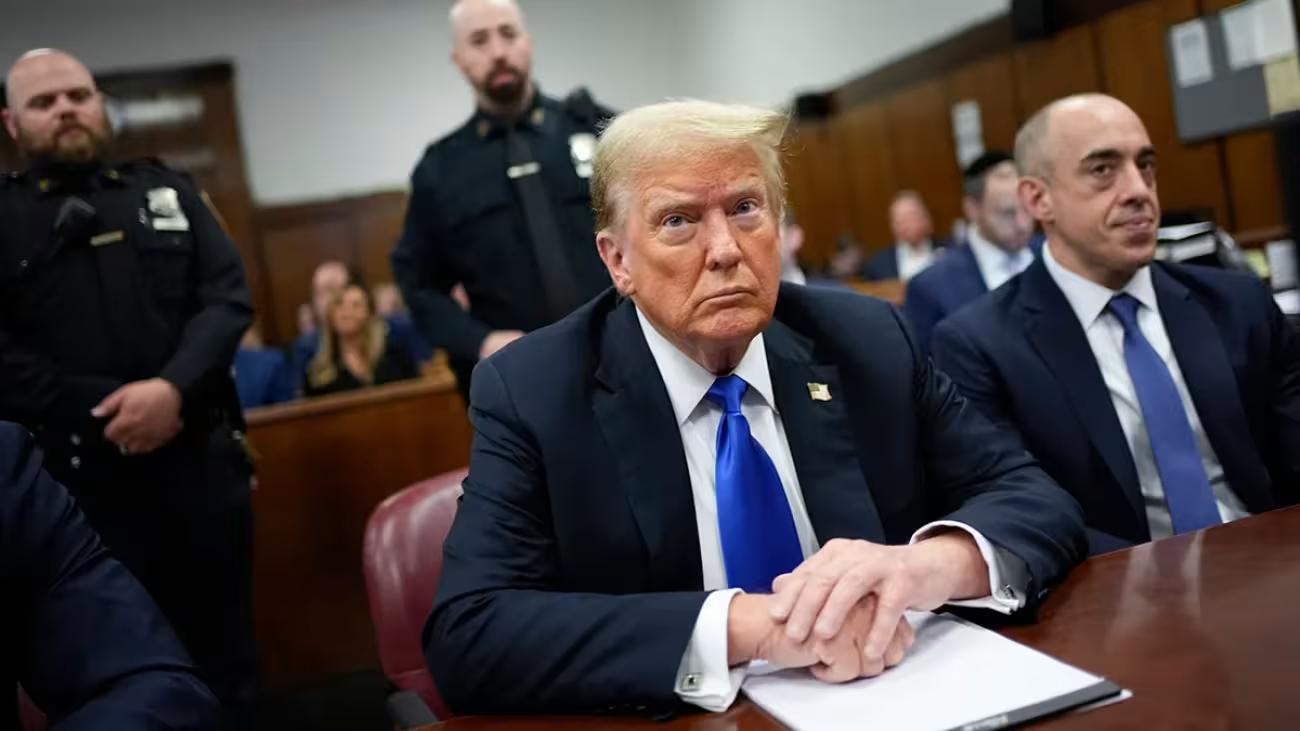
Donald Trump's criminal cases brought the meaning of the word "indicted" into international headlines. In 2023, the former U.S. president faced four separate criminal prosecutions involving alleged election interference, classified government documents, and a payment made to adult-film actress Stormy Daniels.
Trump's indictments were historic because he became the first former U.S. president to face criminal charges. However, being indicted does not mean someone has been convicted or automatically found guilty.
By November 2026, three of the four criminal prosecutions had ended without a trial verdict against Trump. The remaining case, involving falsified business records in New York, resulted in a conviction on 34 felony counts. Trump is still challenging that judgment through the appeals process.
What Does Indicted Mean?
In the United States, an indictment is a formal criminal accusation issued through a legal process, generally involving a grand jury in serious federal cases.
A grand jury is a group of citizens responsible for reviewing evidence presented by prosecutors and determining whether there is sufficient legal basis to bring criminal charges against a person.
In federal felony cases, a grand jury generally consists of 16 to 23 members. At least 12 jurors must agree before an indictment can be returned.
The grand jury does not determine whether the accused person is guilty beyond a reasonable doubt. Its role is to decide whether the prosecution has sufficient grounds to proceed with formal charges.
Once an indictment is issued, the defendant must respond to the charges through the criminal court process.
Does Being Indicted Mean Someone Is Guilty?
No. An indictment is an accusation, not a conviction.
Under American law, defendants are presumed innocent unless prosecutors prove their guilt beyond a reasonable doubt or they enter a guilty plea.
The distinction is important because an indictment only establishes that a criminal prosecution can proceed. It does not establish that the allegations are true.
A criminal case generally involves several stages:
- Investigation: Law enforcement agencies collect evidence and investigate suspected criminal activity.
- Indictment: A grand jury formally approves criminal charges when the required legal threshold is met.
- Arraignment: The defendant appears in court, receives the charges, and enters a plea.
- Trial: Prosecutors and defense attorneys present evidence and arguments.
- Verdict: A jury or judge determines whether the defendant is guilty or not guilty.
- Sentencing: If convicted, the defendant receives a legally determined sentence.
Not every indictment results in a trial. Prosecutors may dismiss charges, courts may dismiss an indictment, or defendants may resolve cases through plea agreements.
What Is the Difference Between Being Indicted and Arrested?
Although the terms frequently appear together in news reports, indictment and arrest describe different legal actions.
An indictment is the formal accusation of a criminal offense. An arrest occurs when law enforcement takes a person into custody under lawful authority.
A person can be indicted without being immediately arrested. Depending on the circumstances, prosecutors may arrange for a voluntary surrender, issue an arrest warrant, or proceed through another lawful method of bringing the defendant before the court.
Trump experienced several different procedures across his four criminal cases. He voluntarily surrendered in New York in April 2023, appeared for arraignment in Florida and Washington, D.C., and was booked at the Fulton County Jail in Georgia in August 2023.
Why Was Donald Trump Indicted?
Trump faced four separate criminal prosecutions in 2023. Each involved different allegations, evidence, prosecutors, and jurisdictions.
The cases concerned his business records, handling of classified documents, efforts to challenge the 2020 presidential election results, and alleged interference with Georgia's election process.
1. New York Hush-Money Case
On March 30, 2023, a Manhattan grand jury indicted Trump on 34 felony counts of falsifying business records in the first degree.
The charges concerned a $130,000 payment made to adult-film actress Stormy Daniels shortly before the 2016 presidential election.
Trump's former lawyer and fixer, Michael Cohen, arranged the payment to prevent Daniels from publicly discussing an alleged sexual encounter with Trump. Trump has denied the alleged encounter.
Prosecutors alleged that Trump later reimbursed Cohen through transactions recorded as legal expenses. They argued that the business records were falsified to conceal a broader scheme connected to the election.
Trump pleaded not guilty and denied wrongdoing.
Trump Was Convicted on All 34 Counts
The case went to trial in April 2024. On May 30, 2024, a Manhattan jury found Trump guilty on all 34 counts.
The verdict made him the first former U.S. president convicted of a criminal offense.
On January 10, 2025, Judge Juan Merchan sentenced Trump to an unconditional discharge. This meant he received no prison time, probation, or financial penalty, but the conviction remained in place.
Trump continued challenging the judgment. On November 5, 2026, a New York appeals court heard arguments from both sides concerning the conviction, including disputes over presidential immunity, the evidence presented at trial, and the prosecution's legal theory.
The judges did not announce a decision or indicate when they would rule. As of November 16, 2026, the state appeal remained pending.
2. Classified Documents Case in Florida
On June 8, 2023, a federal grand jury in Florida indicted Trump over his handling of classified government documents after leaving the White House in January 2021.
Federal prosecutors alleged that Trump retained sensitive national defense information at his Mar-a-Lago residence and obstructed efforts by government authorities to recover the documents.
The original indictment contained 37 counts against Trump. A superseding indictment issued in July 2023 added further allegations and another defendant.
Trump pleaded not guilty and denied the charges.
Why Was the Case Dismissed?
On July 15, 2024, U.S. District Judge Aileen Cannon dismissed the indictment, ruling that Special Counsel Jack Smith's appointment was unconstitutional because he had not been appointed through a process authorized by Congress.
The Justice Department appealed the ruling. However, after Trump won the November 2024 presidential election, prosecutors abandoned the appeal against him in November 2024, citing the department's longstanding position that a sitting president cannot be federally prosecuted while in office.
The case against Trump therefore ended without a criminal trial or verdict on the underlying allegations.
3. Federal Election Interference Case in Washington, D.C.
On August 1, 2023, a federal grand jury in Washington, D.C., indicted Trump on four criminal counts involving alleged efforts to overturn the results of the 2020 presidential election.
Special Counsel Jack Smith alleged that Trump participated in a conspiracy to obstruct the certification of the election and interfere with the peaceful transfer of presidential power.
The four charges included:
- Conspiracy to defraud the United States.
- Conspiracy to obstruct an official proceeding.
- Obstruction of and attempted obstruction of an official proceeding.
- Conspiracy against the rights of citizens.
One important part of the prosecution's allegations concerned the events surrounding January 6, 2021, when a mob of Trump supporters stormed the U.S. Capitol as Congress was certifying Joe Biden's election victory.
Trump pleaded not guilty and denied the allegations.
The Supreme Court's Presidential Immunity Decision
The prosecution faced a major legal obstacle on July 1, 2024, when the U.S. Supreme Court issued its decision in Trump v. United States.
The court ruled that former presidents have absolute immunity from criminal prosecution for actions within their exclusive constitutional authority, presumptive immunity for other official presidential acts, and no immunity for unofficial conduct.
The ruling required lower courts to distinguish between official and unofficial presidential actions when considering criminal charges.
After Trump won the 2024 presidential election, Jack Smith's team moved to dismiss the federal prosecution. The case was dismissed in November 2024 because of the Justice Department's policy against prosecuting a sitting president.
There was no criminal trial or verdict determining Trump's guilt in this case.
4. Georgia Election Interference Case
On August 14, 2023, a grand jury in Fulton County, Georgia, indicted Trump and 18 other defendants in connection with alleged efforts to overturn the state's 2020 presidential election results.
Trump faced 13 counts, including alleged violations of Georgia's Racketeer Influenced and Corrupt Organizations Act, commonly known as RICO.
The prosecution examined alleged efforts to interfere with Georgia's election results, including pressure placed on state officials and activities involving alternative presidential electors.
One widely discussed piece of evidence was Trump's January 2021 telephone conversation with Georgia Secretary of State Brad Raffensperger. During the call, Trump asked Raffensperger to find enough votes to change the election outcome.
Trump denied criminal wrongdoing and pleaded not guilty.
Why Was the Georgia Case Dismissed?
The prosecution encountered serious procedural difficulties after questions arose about District Attorney Fani Willis's relationship with a special prosecutor involved in the case.
In December 2024, a Georgia appeals court disqualified Willis and her office from continuing the prosecution. The case was subsequently transferred to a replacement prosecutor.
In November 2025, newly appointed prosecutor Pete Skandalakis decided not to pursue the case, and the charges against Trump and the remaining defendants were dismissed.
The prosecution therefore ended without a trial or verdict establishing Trump's criminal responsibility for the alleged election interference.
What Happened to Trump's Four Criminal Cases?
Trump's return to the White House in January 2025 significantly changed the status of his criminal prosecutions.
The following table summarizes the outcomes as of November 16, 2026.
| Criminal case | Original charges against Trump | Outcome |
|---|---|---|
| New York hush-money case | 34 felony counts | Convicted on all counts; unconditional discharge; appeal pending. |
| Florida classified documents case | 37 original counts | Dismissed in July 2024; appeal against Trump abandoned in November 2024. |
| Washington, D.C., election case | 4 counts | Dismissed in November 2024. |
| Georgia election case | 13 counts | Dismissed in November 2025. |
These outcomes must be understood separately. The New York case produced a criminal conviction, while the other three prosecutions ended without a trial verdict against Trump.
Can a Sitting U.S. President Be Prosecuted?
The question of whether a sitting president can face criminal prosecution involves constitutional law and longstanding Justice Department policy.
The U.S. Constitution does not explicitly state that a president is immune from every criminal investigation or prosecution.
However, the Justice Department has maintained that prosecuting a sitting president would undermine the functioning of the executive branch. This policy was central to the decision to discontinue the two federal criminal cases against Trump after his 2024 election victory.
The Supreme Court's 2024 immunity decision also established legal protections for certain presidential actions, but it did not grant blanket immunity for private or unofficial conduct.
What Is the Difference Between Indicted, Charged, Arrested, and Convicted?
These legal terms are often used interchangeably in headlines, but they have different meanings.
- Indicted: Formally accused of criminal offenses through an indictment, generally approved by a grand jury.
- Charged: Formally accused of committing a criminal offense. Charges can be brought through different legal procedures.
- Arrested: Taken into custody by law enforcement under lawful authority.
- Convicted: Found guilty following a trial or a guilty plea.
- Acquitted: Found not guilty following a trial.
- Dismissed: A court or prosecutor ends the criminal case or charges without a conviction on those charges.
For example, Trump's New York indictment led to a trial and conviction. By contrast, his federal classified documents indictment was dismissed before a trial could take place.
Trump's Latest Legal Battle in November 2026
Although three of Trump's four criminal prosecutions had ended, his New York conviction continued to generate legal disputes.
On November 5, 2026, the New York Appellate Division heard arguments concerning his appeal of the 34-count conviction.
Trump's attorneys argued that the prosecution relied on an improper legal theory and that certain evidence involving his first presidential administration should have been excluded under the Supreme Court's presidential immunity ruling.
Manhattan prosecutors defended the conviction, arguing that the evidence was admissible and that the jury had sufficient grounds to reach its verdict.
A separate federal appeal concerning Trump's attempt to move the New York state case into federal court was scheduled for November 16, 2026. That proceeding was distinct from the direct state appeal challenging his conviction.
Neither pending appeal should be confused with a new criminal indictment. They are legal challenges to the existing New York judgment and the procedures surrounding it.
Conclusion
Being indicted means that a person has been formally accused of committing a criminal offense. It does not mean that the person has been found guilty or automatically sentenced to punishment.
Donald Trump's four criminal indictments demonstrated how different prosecutions can produce different legal outcomes. Three cases ended without a trial verdict against him, while the New York hush-money case resulted in a conviction on 34 felony counts.
As of November 2026, that conviction remained in place while Trump pursued further appeals. The distinction is essential: an indictment is a formal accusation, a conviction is a finding of guilt, and a dismissal ends a prosecution without necessarily deciding whether the underlying allegations were true.