
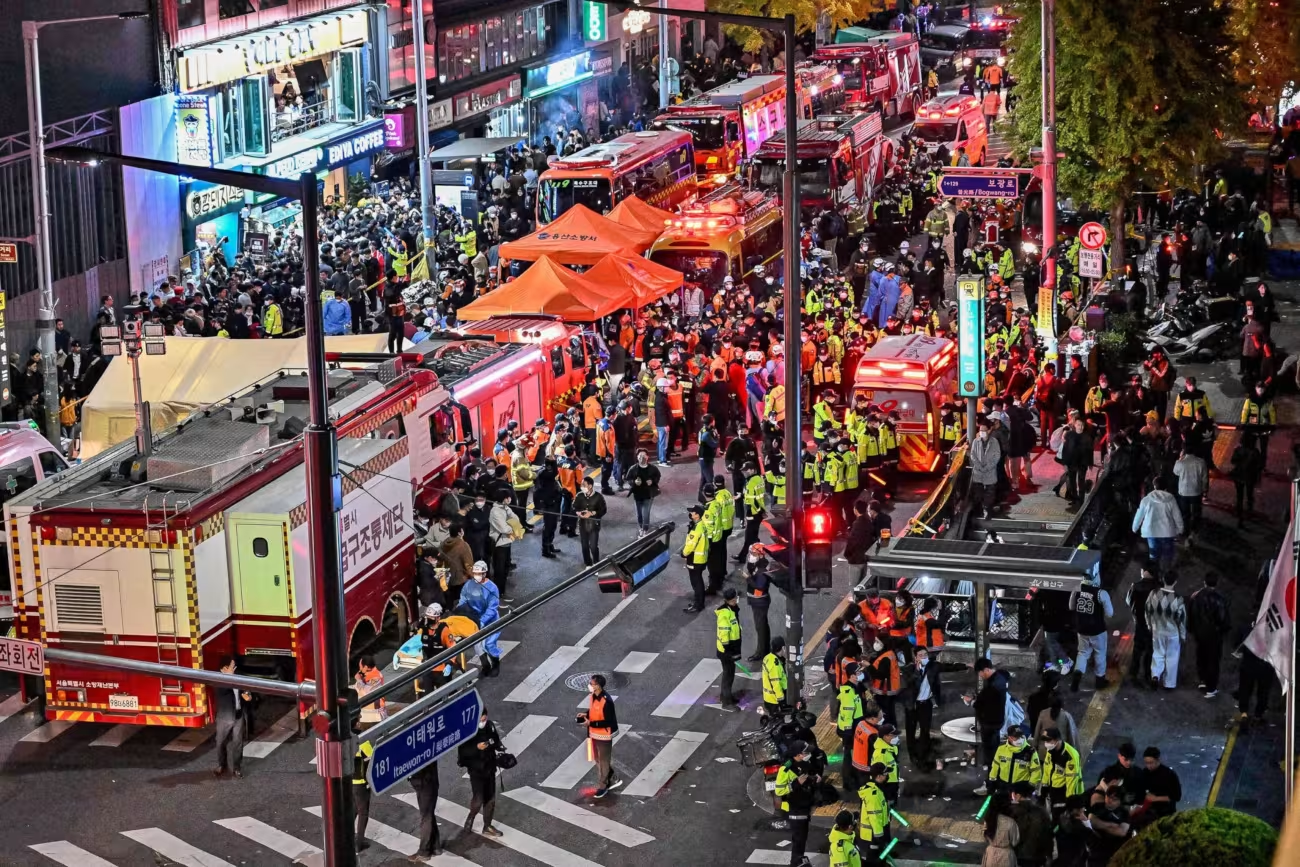
The Itaewon Halloween disaster remains one of the darkest moments in South Korea's recent history. On October 29, 2022, a massive crowd gathered in Seoul's popular Itaewon nightlife district to celebrate Halloween. What should have been an evening of entertainment quickly turned into a devastating crowd crush that killed 159 people and injured 196 others.
The incident occurred in a narrow, sloping alley near Hamilton Hotel, where thousands of pedestrians attempted to move through an increasingly congested area. As crowd pressure intensified, people became trapped and unable to move or breathe. Emergency responders faced an overwhelming situation as casualties continued to accumulate.
Investigations later revealed that authorities had received repeated warnings about dangerous overcrowding several hours before the disaster. Despite these warnings, effective crowd-control measures were not implemented in the affected area.
The tragedy triggered national mourning, public protests, criminal investigations, and demands for accountability from victims' families. It also exposed serious weaknesses in South Korea's disaster management and emergency communication systems.
As of November 2026, investigations into the disaster remain ongoing. A special commission has identified additional institutional failures, while separate criminal proceedings have resulted in convictions, acquittals, and further investigations involving public officials.
What Happened During the Itaewon Halloween Disaster?
The Itaewon crowd crush happened on Saturday, October 29, 2022, in Yongsan District, central Seoul, South Korea.
Itaewon is known for its international restaurants, bars, nightclubs, and entertainment venues. It traditionally attracts large numbers of young people and international visitors, particularly during Halloween celebrations.
In 2022, it was the first major Halloween weekend celebration in Seoul after the relaxation of many COVID-19 restrictions. Consequently, large numbers of people gathered in the district throughout the evening.
Approximately 100,000 people were estimated to have visited the wider Itaewon area for the celebrations. However, the most dangerous congestion developed in a narrow alley near Hamilton Hotel.
The passage was approximately 3.2 meters wide at its narrowest section and had a downhill slope. Pedestrians moving in different directions became trapped as the number of people entering the alley continued to increase.
At approximately 10:15 p.m., the situation escalated into a deadly crowd crush. People began falling, while others were unable to escape the pressure exerted by the surrounding crowd.
Emergency calls reported people suffering from breathing difficulties and becoming unconscious. Rescue workers, firefighters, police officers, and members of the public attempted to help those trapped in the densely packed area.
The incident ultimately killed 159 people and injured 196 others, making it the deadliest crowd crush in South Korean history.
How Many People Died in the Itaewon Halloween Crowd Crush?
The final reported death toll from the Itaewon disaster was 159 people, while 196 others were injured.
The victims were predominantly young adults who had gathered to celebrate Halloween. Many were in their twenties, and the tragedy also affected international visitors living in or travelling to South Korea.
According to disaster statistics compiled by the Asian Disaster Reduction Center, 27 foreign nationals were among those killed.
The victims included people from different nationalities, reflecting Itaewon's international character and its popularity among expatriates and tourists.
Key Casualty Figures
| Incident | Itaewon Halloween Crowd Crush |
|---|---|
| Date | October 29, 2022 |
| Location | Itaewon, Yongsan District, Seoul, South Korea |
| Total Deaths | 159 |
| Total Injuries | 196 |
| Foreign Nationals Among the Deceased | 27 |
| Main Location | Narrow alley near Hamilton Hotel |
| Approximate Alley Width | 3.2 meters |
| Estimated Visitors to Itaewon | Approximately 100,000 |
| Primary Cause of Fatalities | Compression-related asphyxia and injuries |
The scale of the disaster shocked South Korea and prompted comparisons with the 2014 Sewol ferry sinking, another national tragedy that killed hundreds of people.
Why Did the Itaewon Crowd Crush Happen?
The Itaewon disaster was not simply the result of too many people attending a Halloween celebration. Investigations identified a combination of dangerous crowd conditions, insufficient safety planning, inadequate police deployment, and failures in emergency response.
1. Extreme Crowd Density in a Narrow Alley
The alley near Hamilton Hotel became dangerously congested as pedestrians moved in opposite directions.
Some people were attempting to enter the nightlife district, while others were trying to leave. The narrow passage and downhill gradient made it increasingly difficult for pedestrians to maintain control of their movement.
As the crowd became denser, individuals lost the ability to move independently. Pressure from people behind them was transmitted through the packed crowd, creating dangerous physical forces.
When several people fell, others were unable to avoid them because there was insufficient space to move or escape.
2. Lack of Effective Crowd Control
One of the major findings from subsequent investigations was that authorities had not implemented sufficient crowd-control arrangements despite expecting large Halloween crowds.
Police deployment in the district was inadequate for the scale of the gathering. Personnel were not positioned effectively to regulate pedestrian movement through the narrow alley.
The special investigation commission later confirmed that no dedicated crowd-control police units had been deployed at the disaster scene.
This finding raised serious questions about why the authorities failed to organize a more comprehensive safety operation for an event that attracted tens of thousands of visitors.
3. Failure to Act on Emergency Warnings
Perhaps the most disturbing aspect of the disaster was that members of the public had warned police about dangerous crowd conditions several hours before the fatal crush.
These reports described people becoming trapped, struggling to move, and facing the possibility of being crushed.
Despite receiving repeated warnings, the police response did not adequately address the developing danger.
4. Inadequate Emergency Coordination
The disaster also exposed weaknesses in communication between police, firefighters, local authorities, and central government agencies.
Although South Korea had systems designed to coordinate emergency responses, those systems were not used effectively during the incident.
As the number of casualties increased, emergency responders struggled to access the affected area, coordinate rescue operations, and manage the large number of people requiring medical assistance.
Police Received 11 Emergency Calls Before the Disaster
One of the most significant revelations from the Itaewon investigation involved 11 emergency calls made to South Korea's police emergency number, 112, before the crowd crush occurred.
The first warning came at approximately 6:34 p.m. on October 29, almost four hours before the fatal incident.
The caller described dangerous congestion in the narrow alley and warned that people could be crushed if the situation continued.
Rather than treating the report as an indication of a potentially serious crowd disaster, the response failed to produce effective crowd-control measures.
Timeline of the Emergency Calls
| Time | Development |
|---|---|
| 6:34 p.m. | First emergency call warning about dangerous overcrowding in the alley. |
| 8:33 p.m. | Another caller reported people falling and being injured because of the crowd. |
| 9:00 p.m. | A further emergency report warned that the crowd was approaching a dangerous situation. |
| 9:07 p.m. | A caller warned that people could be crushed and requested police intervention. |
| 10:11 p.m. | The final warning call in the series was received shortly before the disaster. |
| 10:15 p.m. | Fire authorities received the first emergency call reporting the crowd-crush incident. |
| 10:29 p.m. | Initial emergency responders arrived at the scene. |
| 10:43 p.m. | Fire authorities issued the first emergency response level. |
| 11:13 p.m. | Emergency response level increased to the second stage. |
| 11:48 p.m. | The highest emergency response level was activated. |
The 11 calls between 6:34 p.m. and 10:11 p.m. demonstrated that the risk had been reported repeatedly before the disaster.
According to the National Commission for the Investigation of the October 29 Itaewon Disaster, its March 2026 public hearings examined failures across all four stages of the police response system: receiving emergency calls, analyzing and monitoring reports, issuing operational instructions, and deploying officers.
The commission concluded that these stages failed simultaneously despite the existence of relevant procedures, personnel, and communication systems.
How Emergency Workers Responded to the Itaewon Disaster
Once the crowd crush occurred, emergency workers faced an exceptionally difficult rescue operation.
Many victims were trapped beneath or within the densely packed crowd. Firefighters and paramedics needed to remove people from the area while providing immediate medical assistance.
Members of the public also attempted to help, with some performing cardiopulmonary resuscitation (CPR) on unconscious victims while waiting for emergency personnel.
The sudden number of casualties overwhelmed available medical resources in the immediate area.
Emergency teams had to manage multiple priorities, including extracting victims, performing CPR, transporting injured people, and coordinating hospital treatment.
The incident also highlighted the importance of controlling pedestrian access around a disaster site. Without sufficient access routes, emergency vehicles and rescue teams can experience delays reaching people who urgently need assistance.
New Investigation Reveals Additional Questions About Victims' Deaths
In July 2026, South Korea's special investigation committee released an additional medical review concerning the deaths in Itaewon.
The review found that 15 victims did not appear to have died from suffocation, although their exact causes of death could not be established through the examination.
Investigators suggested that some may have experienced internal bleeding or other medical complications caused by extreme pressure on muscles and internal organs.
The findings raised further questions about whether more victims could have survived if rescue operations had been initiated more actively and earlier.
Forensic pathologist Kim Moon-young explained that some conditions associated with internal injuries may not cause immediate death, potentially leaving a period during which medical intervention could have made a difference.
However, the committee emphasized that the analysis relied on external examinations rather than full autopsies. Consequently, the findings do not establish the precise cause or timing of death for those 15 individuals.
The review has nevertheless strengthened calls for improvements in emergency medical response and rescue procedures during large-scale crowd disasters.
South Korea's Investigation Into the Itaewon Disaster
Following the disaster, South Korean authorities launched investigations into the responsibilities of police departments, firefighters, local government officials, and central government agencies.
The initial special police investigation team began operating on November 1, 2022, and included approximately 501 personnel.
In January 2023, investigators concluded that the disaster was preventable and resulted from failures by authorities to establish appropriate safety measures and respond promptly to emergency warnings.
The investigation referred 23 government officials to prosecutors for possible criminal charges involving professional negligence and other offences.
The findings also raised concerns about internal police reports that had warned of potential overcrowding and safety risks before Halloween.
Investigators alleged that some reports were deleted after the disaster, creating further questions about the handling of evidence and institutional accountability.
Former Yongsan Police Chief Sentenced to Three Years in Prison
One of the most significant criminal proceedings involved Lee Im-jae, the former chief of Yongsan Police Station, whose jurisdiction included Itaewon.
On September 30, 2024, the Seoul Western District Court sentenced Lee to three years in prison for professional negligence resulting in death and injury.
The court concluded that the danger created by large Halloween crowds in Itaewon's narrow, sloping alleyways could have been anticipated.
It found that Lee had failed to implement appropriate preventive measures, including deploying sufficient personnel and controlling nearby traffic.
The ruling was important because it represented one of the first major criminal convictions of a senior official connected to the disaster.
Another former police official, Song Byung-joo, who had led the Yongsan police station's emergency situation room, received a two-year prison sentence in the same proceedings.
Former Yongsan District Chief Acquitted
The same court acquitted former Yongsan District Office chief Park Hee-young and several other local government officials.
The court reasoned that the relevant legislation at the time did not clearly establish an obligation for local authorities to prepare specific crowd-management plans for events without an official organizer.
The decision generated criticism from victims' families, who argued that local government officials should have taken greater responsibility for public safety.
Prosecutors subsequently appealed several aspects of the first-instance decisions, while the convicted police officials also challenged their sentences.
Former Seoul Metropolitan Police Chief Acquitted
On October 17, 2024, the Seoul Western District Court acquitted Kim Kwang-ho, the former chief of the Seoul Metropolitan Police Agency, of professional negligence charges related to the disaster.
The court determined that prosecutors had not sufficiently established a direct connection between his alleged negligence and the deaths or injuries.
The decision was controversial because Kim was one of the highest-ranking police officials investigated over the tragedy.
Victims' families expressed disappointment with the ruling and continued demanding accountability from senior government officials.
2026 Investigation: Police Prioritized Anti-Drug Operations Over Crowd Safety
One of the most significant developments in the continuing investigation emerged during public hearings held on March 12, 2026.
The National Commission for the Investigation of the October 29 Itaewon Disaster examined why police had failed to organize adequate crowd-control operations despite anticipating a large Halloween gathering.
The commission also investigated whether police resources had been disproportionately directed toward protests and demonstrations near the Presidential Office following its relocation to Yongsan.
Another major issue involved the deployment of approximately 50 special criminal investigators to Itaewon for anti-drug enforcement on the night of the disaster.
According to the commission's findings, 49 detectives were assigned to drug-enforcement operations, while no dedicated crowd-control police units were deployed at the scene.
The hearings questioned why police intelligence about the expected crowds and potential safety risks had not been adequately communicated to the relevant operational divisions.
Investigators also examined whether national anti-drug policies had influenced police priorities at the expense of public safety preparations.
The findings raised broader questions about how government agencies allocate resources when public safety risks and other law-enforcement priorities occur simultaneously.
October 2026: Investigation Finds Serious Failures in South Korea's Disaster Response System
On October 27, 2026, the National Commission for the Investigation of the October 29 Itaewon Disaster presented an interim assessment of its investigation.
The commission identified nine major areas requiring further examination, including police deployment, emergency command structures, government communications, and inconsistencies in official records.
Its findings indicated that the disaster response system had failed to function effectively despite multiple warning signs.
Presidential Instructions Were Delayed
One particularly significant finding concerned the distribution of instructions issued by former President Yoon Suk Yeol during the emergency.
The commission reported that the instructions were not communicated to relevant agencies for 55 minutes.
Investigators also examined changes to the National Crisis Management Basic Guidelines concerning the role of the Presidential Office as a disaster-response control tower.
These findings raised questions about the clarity of responsibility and the ability of central government institutions to coordinate emergency responses.
Police Records and Emergency Communications
The commission also examined allegations that records relating to police responses to 112 emergency calls had been revised after the disaster.
Investigators compared emergency call records, radio communications, CCTV footage, internal documents, and witness testimony to reconstruct what happened.
The purpose was to establish whether official records accurately reflected the decisions and actions taken by relevant agencies before and during the disaster.
Five Areas Targeted for Institutional Reform
The commission identified five major areas where South Korea needs improvements to reduce the risk of similar disasters:
- Disaster response manuals: Improving procedures and clearly assigning responsibilities during large-scale emergencies.
- Disaster safety communications: Strengthening communication between police, firefighters, local authorities, and central government.
- Central disaster coordination: Improving the operation of the Central Disaster and Safety Countermeasures Headquarters.
- Emergency rescue and medical response: Strengthening rescue operations, medical coordination, and emergency treatment.
- Handling of deceased victims: Improving procedures for recovering victims, identifying remains, and supporting bereaved families.
The commission also announced plans to question former President Yoon Suk Yeol and former Interior and Safety Minister Lee Sang-min as part of its continuing investigation.
September 2026: Joint Investigation Team Ends Its Work
Another important development occurred on September 30, 2026, when the joint prosecution and police investigation team established to examine the Itaewon disaster concluded its activities.
The team had been operating since July 2025 and investigated the causes of the disaster, potential official negligence, and secondary harm suffered by victims and their families.
During its work, prosecutors indicted former Yongsan Fire Station chief Choi Seong-beom without detention on charges of professional negligence resulting in death and injury.
The investigation also led to criminal proceedings against three individuals accused of causing secondary harm to victims and bereaved families, including through defamatory publications.
However, the team decided not to prosecute several other officials because it concluded that the available evidence was insufficient to establish the alleged offences.
These decisions included allegations involving Seoul Mayor Oh Se-hoon, former Yongsan District Office chief Park Hee-young, and former acting National Fire Agency Commissioner Nam Hwa-young.
Some matters requiring further investigation were transferred to the National Police Agency.
The closure of the joint investigation team did not mean that all investigations into the disaster had ended. The separate national special commission continued its truth-finding work.
Special Investigation Commission Extended Until September 2027
On September 15, 2026, an amendment to South Korea's special law concerning the Itaewon disaster took effect, extending the investigation period of the National Commission for the Investigation of the October 29 Itaewon Disaster by one year.
The commission's mandate now runs until September 16, 2027.
The extension followed concerns that the investigation had not completed its work within the original period and that victims' families remained dissatisfied with the progress of efforts to establish accountability.
The commission stated that it would concentrate on identifying structural causes and determining the responsibilities of state institutions.
It also committed to examining institutional weaknesses and developing measures intended to prevent similar disasters.
Consequently, the Itaewon investigation remains an active national issue rather than a completely closed historical case.
How the Itaewon Disaster Changed South Korea's Approach to Crowd Safety
The disaster exposed weaknesses in the way South Korea managed large gatherings that did not have a single official organizer.
Before the incident, Halloween celebrations in Itaewon were largely spontaneous gatherings involving visitors to bars, restaurants, and entertainment venues.
Because there was no central event organizer, responsibility for managing the crowds was not clearly coordinated between the police, local government, and other authorities.
The tragedy demonstrated that large crowds can create serious public safety risks even when no formal event has been organized.
Several important lessons emerged from the incident.
Better Crowd Risk Assessment
Authorities need to evaluate the physical characteristics of public spaces, expected pedestrian numbers, movement patterns, and potential bottlenecks before large gatherings take place.
Areas with narrow streets, steep slopes, and limited exit routes require particular attention.
Real-Time Crowd Monitoring
Modern crowd management requires reliable information about pedestrian density and movement.
Police and emergency agencies need systems that allow them to identify dangerous congestion before it develops into a life-threatening situation.
Clear Institutional Responsibility
Disaster prevention cannot depend on whether a gathering has a formal organizer.
Government institutions need clearly defined responsibilities for identifying risks, coordinating crowd control, and activating emergency responses.
Faster Emergency Communication
The 11 emergency calls made before the Itaewon disaster demonstrated the importance of acting on public warnings.
Emergency communication systems must ensure that serious reports are assessed, escalated, and translated into practical action without unnecessary delays.
Remembering the Victims of the Itaewon Halloween Disaster
The Itaewon crowd crush left lasting emotional and social consequences for survivors, victims' families, and the wider South Korean community.
Many of the victims were young people who had gone out to enjoy Halloween celebrations. Their deaths created profound grief among families, friends, classmates, and colleagues.
Following the incident, memorials and public mourning events were held across South Korea. People placed flowers, candles, and messages of remembrance near the site of the disaster.
Victims' families continued campaigning for a more comprehensive investigation, greater institutional accountability, and improved support for survivors.
For many relatives, the issue has never been limited to determining which individuals should face criminal punishment. They have also sought a complete explanation of why the disaster happened and why repeated warnings failed to prevent it.
The continuing investigation reflects the importance of answering those questions and ensuring that the lessons from Itaewon lead to meaningful changes in public safety.
Conclusion
The October 29, 2022, Itaewon Halloween crowd crush was a devastating disaster that killed 159 people and injured 196 others in Seoul, South Korea.
The tragedy developed in a narrow alley where extreme crowd density, dangerous pedestrian movement, and insufficient crowd management created conditions that led to fatal compression.
Subsequent investigations revealed that police had received 11 emergency warnings before the incident but failed to implement effective preventive measures. The disaster also exposed serious weaknesses in emergency communication, institutional coordination, and government accountability.
Although several public officials have faced criminal proceedings, questions surrounding the broader institutional responsibility remain unresolved.
In 2026, the national investigation commission identified additional failures involving police deployment, anti-drug operations, presidential instructions, and emergency command structures. Its investigation has been extended until September 16, 2027.
The Itaewon disaster remains an important reminder that public safety at large gatherings requires preparation, effective crowd management, rapid emergency communication, and clearly defined government responsibilities. Remembering the 159 people who lost their lives must also involve ensuring that preventable crowd disasters do not happen again.